
AFCI vs. GFCI: What’s the Difference and Where Each Goes
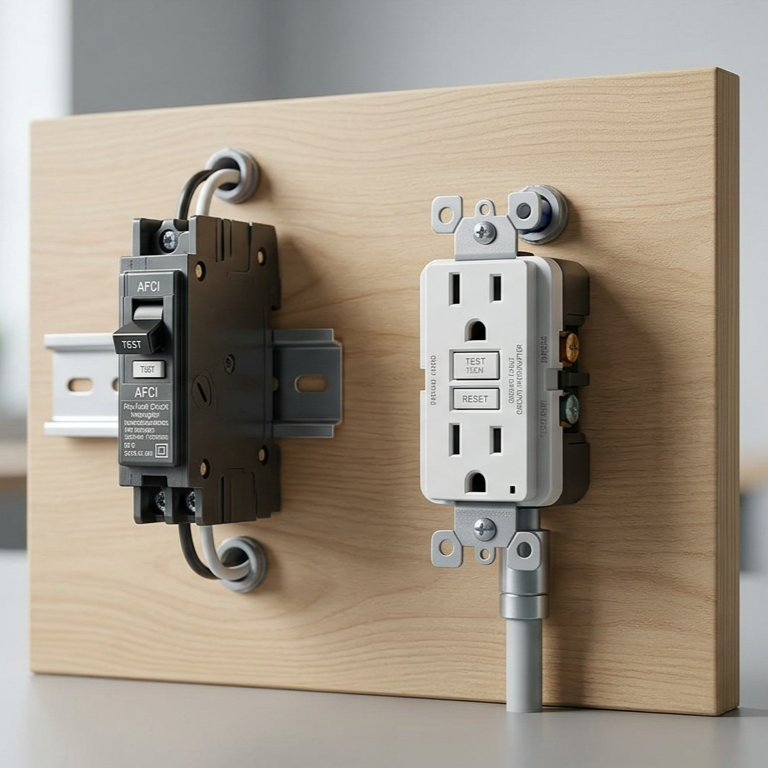
Quick Answer: AFCI and GFCI are two safety devices that protect against two different dangers. A GFCI (ground-fault circuit interrupter) protects people from electric shock by cutting power instantly when electricity starts flowing along an unintended path, such as through water or a person — which is why it's used near water, in kitchens, bathrooms, laundry rooms, garages, and outdoors. An AFCI (arc-fault circuit interrupter) protects against fire by detecting the dangerous arcing of damaged or loose wiring, and it's used in living areas like bedrooms and family rooms. Combination devices provide both. They aren't interchangeable, because each detects and prevents a different hazard.
AFCI and GFCI look alike on paper and sound nearly identical, but they guard against two very different dangers — one mainly shock, the other fire. Understanding what each does and where it belongs explains why a properly protected home uses both, and why you can't substitute one for the other.
What a GFCI Does
A GFCI protects people from electric shock. In a normal circuit, the current flowing out through the hot wire returns in an equal amount through the neutral wire. A GFCI continuously compares the two. If it detects even a small imbalance — meaning some current is escaping along an unintended path, like through water or through a person to ground — it cuts the power almost instantly, fast enough to prevent a dangerous shock.
That's why GFCIs are placed wherever water and electricity could meet: kitchens, bathrooms, laundry rooms, garages, basements, and outdoor receptacles. Water provides the path to ground that makes shocks possible, and the GFCI is designed to catch that leakage the moment it begins.
What an AFCI Does
An AFCI protects against fire. The hazard it watches for is arcing — the sparking that occurs when electricity jumps across a gap in damaged, frayed, loose, or deteriorating wiring or connections. These arcs can reach very high temperatures and ignite nearby wood, insulation, or dust, and they're a recognized cause of electrical fires. The danger is that arcing can happen inside walls, out of sight.
An AFCI recognizes the distinctive electrical signature of a dangerous arc and shuts the circuit down before it can start a fire. Because the aim is to prevent fires where people live and sleep, AFCI protection is used in living areas such as bedrooms, living rooms, and family rooms.
Two Hazards, Side by Side
The simplest way to keep them straight is by the danger each one addresses.
| GFCI | AFCI | |
|---|---|---|
| Protects against | Electric shock | Electrical fire |
| Detects | Current leaking to ground | Dangerous arcing in wiring |
| Typical locations | Kitchens, baths, garages, outdoors | Bedrooms, living areas |
| What triggers it | Imbalance of hot and neutral | Arc-fault signature |
| Primary purpose | Personal safety from shock | Fire prevention |
Why They Aren't Interchangeable
Because they detect different things, neither can do the other's job. A GFCI looking for current leaking to ground won't recognize a dangerous arc in a loose connection that isn't leaking to ground. An AFCI watching for arc signatures isn't designed to protect a person from shock the way a GFCI is. Installing the wrong one in a given spot leaves a real hazard uncovered. This is precisely why modern homes use both, each placed where its specific protection matters — shock protection near water, fire protection in living spaces.
Where Combination Devices Fit
For locations that require both protections, combination AFCI/GFCI devices are available, providing both in a single breaker or outlet. These are useful where both hazards are present at once. The right combination of GFCI, AFCI, and dual-protection devices for a given home depends on the layout and how each circuit is used, which is part of why mapping it out is best left to an electrician rather than guessed at.
If a GFCI or AFCI keeps tripping, resist the urge to replace it with a standard breaker just to stop the nuisance. The device is detecting something — a ground fault or an arc. Repeated tripping is worth investigating, because it may be catching a genuine fault that a standard breaker would let continue.
Why Getting It Right Matters
These devices exist because they prevent the two most common serious electrical hazards in a home: shock and fire. Having the correct type in the correct place is the difference between real protection and its appearance. Older homes are a frequent gap — many were built before these protections were standard, so they may have outlets near water with no shock protection and living-area circuits with no arc-fault protection. Adding the right devices is one of the more meaningful safety upgrades a home can get. An electrician can map which circuits have protection now, which need it, and where combination devices make sense, so the home is covered against both dangers. Remodels and additions are another good moment to review coverage, since new circuits and reconfigured rooms change where each kind of protection belongs. The same applies any time you notice a device tripping repeatedly: rather than a nuisance to silence, it's often the system flagging a condition that's worth understanding before it becomes a shock or a fire. In that sense, these devices do more than react in an emergency; they also serve as early warnings, telling you when a circuit has developed a fault that would otherwise stay hidden inside the walls until it caused harm.
Frequently Asked Questions
A GFCI protects people from electric shock by cutting power when current leaks along an unintended path, such as through water. An AFCI protects against fire by detecting dangerous arcing in damaged or loose wiring. They address different hazards — shock versus fire — and detect different conditions, so they serve distinct, non-overlapping purposes in a home's electrical safety.
GFCIs are used where water and electricity could meet: kitchens, bathrooms, laundry rooms, garages, basements, and outdoor receptacles. Water creates the path to ground that causes shocks, and the GFCI detects that leakage and cuts power instantly. Anywhere moisture is likely near an outlet is a place where GFCI protection belongs.
AFCIs are used in living areas such as bedrooms, living rooms, and family rooms, where the goal is to prevent electrical fires from arcing in the wiring. Because arcing can ignite fires inside walls in the spaces where people spend time and sleep, fire protection is prioritized in those areas.
No, they aren't interchangeable. A GFCI detects current leaking to ground to prevent shock, while an AFCI detects arcing to prevent fire. One won't perform the other's function, so substituting leaves a hazard unprotected. Each should be used where its specific protection is needed, and combination devices cover both where appropriate.
Because it's detecting something it's built to catch — a ground fault for a GFCI or arcing for an AFCI — though certain devices or wiring conditions can also cause nuisance tripping. Repeated tripping shouldn't be bypassed with a standard breaker; it's worth having an electrician check, since it may be catching a genuine fault that needs attention.
It's a single breaker or outlet that provides both arc-fault and ground-fault protection, guarding against both fire and shock at once. These are useful in locations where both hazards are present. An electrician can determine where combination protection is appropriate versus where a single type suffices, based on the home's layout and circuit use.
Two Devices, Two Different Jobs
AFCI and GFCI protection look and sound alike but defend against entirely different dangers — GFCIs stop shocks near water, AFCIs stop fires from arcing in living spaces. They can't substitute for each other, which is why a safe home uses each where it belongs, plus combination devices where both risks meet. Getting the right protection in the right place is what genuinely keeps you safe.
Want to be sure your home has the right shock and fire protection? — Get your circuits evaluated for proper AFCI and GFCI coverage. RSB Electrical Inc. serves Mesa and the Phoenix Valley. ROC 167102. Call (480) 485-4284.