
Ceiling Fan Wobble: The 7 Causes and the One Real Danger
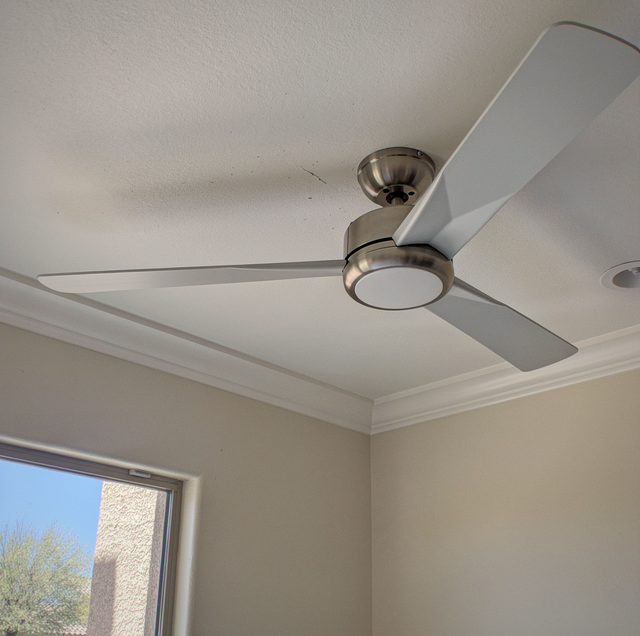
Quick Answer: A ceiling fan wobbles because something has thrown it out of balance or the mount has loosened. The usual culprits are dust on the blades, loose blade or bracket screws, a bent or warped blade, blades that no longer match, or an out-of-round motor. Most are safe to check yourself. The one that is not safe is a fan hung on an outlet box that was never rated to carry a spinning load, because that fan can fall.
A little movement at the tips of the blades is normal. A pronounced shimmy that rattles the light kit, makes the canopy tick against the ceiling, or shakes the whole fixture is not. Almost every wobble comes down to one of two problems: the spinning part is no longer balanced, or the part that holds it up has come loose. Sorting out which one you have tells you whether this is a ten-minute fix with a screwdriver or a reason to shut the fan off and call an electrician.
What Makes A Fan Wobble In The First Place
A ceiling fan is a set of long, flat blades turning around a central hub several times a second. For it to spin smoothly, the weight has to be distributed evenly around that hub, the way the weights on a tire keep a wheel from shaking the steering column at highway speed. When one blade carries a little more weight than the others, or sits at a slightly different height or angle, the hub gets pulled toward the heavy side on every rotation. That repeating pull is the wobble you see.
Weight imbalance and mounting looseness feed each other. A fan that starts with a mild imbalance shakes the bracket and screws a bit more with every hour it runs, and over months that vibration walks screws loose, which lets the fan tilt, which makes the imbalance worse. That is why a fan can seem fine for two years and then develop a shake that grows week over week. It also means the fix has two halves: rebalance the moving part, and re-secure the mount that holds it.
Before touching anything, know the split between what is safe for a homeowner and what is not. Cleaning blades and tightening the visible screws on the blades, the mounting bracket, and the downrod are safe with the power to the fan switched off. Anything behind the ceiling, meaning the electrical box, the wiring, or the motor housing, is licensed-electrician work. And a fan that wobbles violently should be switched off at the wall and left off until it is fixed, not run "gently" in the meantime.
The Safety Issue That Comes First
The single most dangerous cause of a wobble has nothing to do with the blades. It is a fan mounted to the wrong electrical box.
A ceiling fan must hang from a box that is listed and labeled to support a fan, often stamped "Acceptable for Fan Support" or sold as a fan-braced box. A standard lighting outlet box is built to hold the static weight of a light fixture, a few pounds that never moves. A fan adds two things a light never does: real weight, often fifteen to fifty pounds, and constant vibration. A standard box screwed only to a thin ceiling can loosen under that load, and in the worst case the box pulls free and the running fan drops.
Here is the trap. A fan mounted on a non-rated box often works for a while, and the growing wobble is the warning sign that the mount is failing. So a wobble that appears on a fan you know was hung where a light fixture used to be, or one that came with the house and you cannot confirm the box, deserves real caution. If the fan visibly droops, if the canopy has pulled away from the ceiling, or if you can rock the whole fan by hand at the ceiling, switch it off at the breaker and have the box checked before running it again. Confirming and replacing an electrical box is not a homeowner job, because it means working in the ceiling with the wiring exposed.
A ceiling fan must hang from a box listed and labeled to support a fan, not a standard lighting box built only for a stationary light. If the fan visibly droops, the canopy has pulled away from the ceiling, or you can rock the whole fan by hand at the ceiling, switch it off at the breaker and have the box checked before running it again, because a fan on the wrong box can pull free and drop.
Fan-rated box versus a standard box: A fan-rated box is a heavier metal box anchored to the framing, either screwed directly into a joist or carried on an expanding brace bar that spans between two joists and locks against them. It is designed and tested to hold a moving fan. A standard box is a lighter box meant for a stationary light, often tacked to a single furring strip or the drywall edge. From below, with the canopy on, the two can look identical, which is exactly why a wobble on an unknown mount should be treated as a possible mounting problem and not just a dusty-blade problem.
The Homeowner-Safe Checks And Fixes
Most wobbles are cured by the steps below, in order, with the fan switched off at the wall switch before you touch the blades.
Clean the blades: Dust does not land evenly. One blade collects a heavier film than the next, and that uneven grime is enough to unbalance the fan. Wipe every blade top and bottom with a slightly damp cloth, and wipe each one the same way so you do not leave more residue on some than others. Cleaning is often the entire fix, and it is worth doing first because it costs nothing.
Tighten the blade screws: Each blade attaches to a metal arm, called a blade iron or bracket, with two or three screws, and that arm bolts to the motor with its own screws. Vibration loosens all of them over time. With a screwdriver, snug every blade-to-arm screw and every arm-to-motor screw. Do not overtighten into the blade material, especially wooden or composite blades, because a stripped hole is worse than a loose one.
With the fan off, measure from the tip of each blade straight up to the ceiling, turning the blades by hand to bring each to the same spot. If one blade hangs lower or higher than the rest, its arm may be slightly bent, and a gentle even bend back into line often levels it. Blades should also be a matched set.
Use a balancing kit: If cleaning, tightening, and leveling still leave a shimmy, a balancing kit finishes the job. The kit is a plastic clip and a few stick-on weights. Clip the weight to the middle of one blade, run the fan, and see if the wobble improves or worsens. Move the clip blade to blade until you find the one where it helps most, then stick a weight to that blade at the spot that smooths it out. This is the same logic as balancing a tire, done by trial and error with the clip standing in for the wheel-balancing machine.
Check the downrod and canopy: The downrod is the metal pipe between the ceiling mount and the motor. Where it meets the mounting bracket, there is a cross pin and a set screw, and if either is loose, the whole fan can tilt and wobble even when the blades are perfect. With the power off, check that the downrod set screw is tight and the canopy sits flush to the ceiling. A canopy that has slipped down the rod is a sign the mount above it needs attention.
Warped, Bent, And Mismatched Blades
Sometimes the blades themselves are the problem, not their balance adjustment. Wood and MDF blades can warp when they absorb moisture from a humid room or a swamp cooler, and a warped blade cuts the air unevenly no matter how you weight it. Lay a suspect blade on a flat surface, or sight down its length, to see if it has cupped or twisted. A warped blade is replaced as a full matched set, not straightened.
Bent blade arms are different from warped blades. The arm is metal and can be gently trued back to level, while the blade is the flat vane and, once warped, does not recover. If the fan took a hit from a thrown toy, a tall piece of furniture, or a mover's box, both can happen at once. And the seasonal note that matters year-round: it is not only summer humidity that stresses blades. A room that swings from air-conditioned and dry in the warm months to closed-up and damp in the cool ones puts blades through repeated moisture cycles, and it is that back-and-forth, not any one season, that eventually warps a marginal blade.
When It Is Time To Call An Electrician
Reach for the phone rather than the screwdriver when the wobble points behind the ceiling or into the motor.
Call an electrician if the fan is on a box you cannot confirm is fan-rated, if the box or bracket feels loose in the ceiling, or if the canopy has pulled away from the surface, because that is the mounting-safety case and it means opening the ceiling. Call if the fan wobbles and hums, grinds, or runs hot, since an out-of-round motor or a failing bearing is an internal fault, not a blade adjustment. Call if any wiring is exposed or discolored, or if the fan trips a breaker, and always have the power off at the breaker for that circuit before anyone works near the connections. An out-of-round motor, where the rotating part no longer spins true on its shaft, produces a wobble that no amount of cleaning or balancing will cure, and diagnosing it means getting inside the motor housing safely.
The rule of thumb is simple. If the fix is on the blades or the visible screws, it is yours to do with the power off. If the fix is in the box, the wiring, or the motor, it belongs to a licensed electrician, and a badly wobbling fan should stay off until then.
Frequently Asked Questions
There is no fixed timeline, but a wobble driven by loosening screws tends to accelerate, because each bit of extra shake loosens the hardware a little more on every rotation. A brand-new fan that wobbles from day one is usually a balance or blade-matching issue and stays roughly constant. A fan that developed a wobble after years of smooth running is more often a mount working loose, and that kind is the one to catch early rather than let compound.
No, and higher speed usually makes it worse. Imbalance forces grow with the square of the rotational speed, so a blade that is slightly heavy produces roughly four times the sideways pull at high speed as it does at half that speed. A fan that wobbles only on high, and runs smoothly on low, still has a real imbalance worth correcting rather than a speed you should simply avoid.
Yes, on a sloped or textured ceiling. If the mounting bracket is not seated flat, or a sloped ceiling exceeds the angle the standard mount allows, the fan hangs off-axis and wobbles no matter how balanced the blades are. Fans on ceilings steeper than a typical bracket handles need a sloped-ceiling adapter, a longer downrod, and sometimes both, so the motor hangs plumb.
A longer downrod generally makes an existing wobble more visible at the blade tips, because the fan hangs farther from the mount and small tilts are magnified over the extra length, the way a longer pendulum swings wider. A longer rod does not cause imbalance, but it will exaggerate one, so on high ceilings it is doubly worth getting the balance and the mount right.
The energy penalty is minor, but the mechanical wear is not. A persistent wobble loads the motor bearings sideways, a direction they are not built to carry, which shortens bearing life and is a common reason an older fan starts to hum or grind. Correcting a wobble early is as much about protecting the motor as it is about the annoyance.
That points to the light kit or its glass shades, not the blades. A shade tightened unevenly, a heavier replacement bulb on one side of a multi-bulb fixture, or a light kit whose screws have loosened can add off-center weight below the hub. Check that all shades are seated the same, that bulbs match, and that the light-kit mounting screws are snug, with the power off, before assuming the fan itself is at fault.
Book a fan-mount safety check — confirm your box is fan-rated before the wobble becomes a hazard. RSB Electrical Inc. serves Mesa and the Phoenix Valley. ROC 167102. Call (480) 485-4284.
