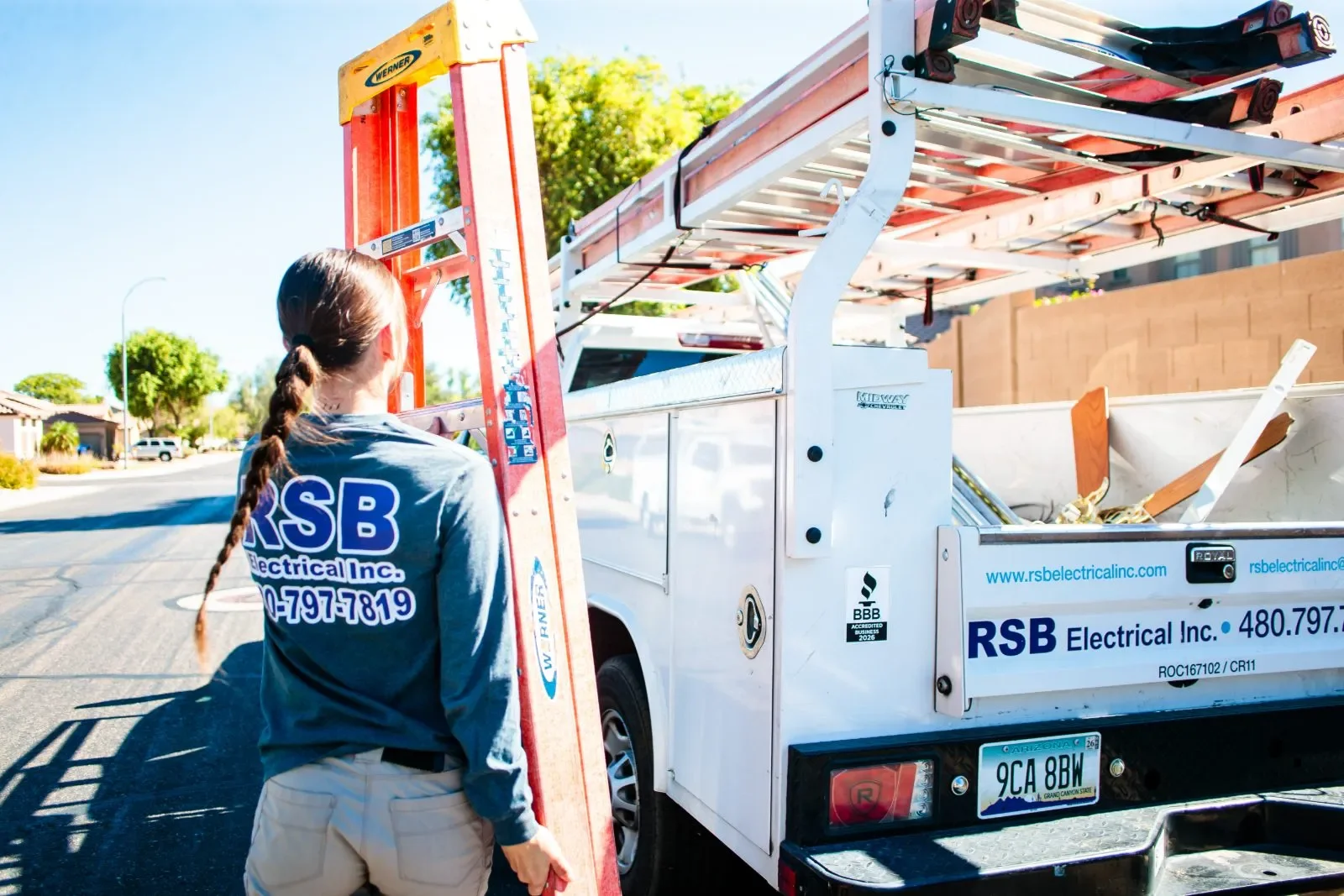
24-hour emergency electrician Maricopa AZ RSB service truck
Home Service Areas Maricopa Emergency Electrician
AZ ROC License #167102 (CR-11) Family-Owned & Operated Since 2001 Available 24/7 Free Estimates Licensed & Insured Highly Rated on Google

24-Hour Emergency Electrician in Maricopa, AZ

The Fault That Waits for Summer | AZ ROC License #167102 (CR-11) | Family-Owned Since 2001 | Available 24/7

Somebody calls in August about a circuit that has behaved impeccably since they moved in. Nothing has been added, nothing has been changed, and it has started tripping at six in the evening. They are usually apologetic about wasting anybody's time.

There is no need. A whole category of electrical fault stays invisible through the cool months and then, as the afternoons climb, starts turning up in houses where nothing has changed and nobody has done anything. Knowing why is most of what makes a summer night call go quickly.

24/7 on-call electrician answers CR-11 licensed & insured Since 2001 family-owned
A real electrician answers 24/7 Free estimate Written quote, honored 30 days
What It Looks Like

Faults That Keep Summer Hours

Six patterns worth recognizing. Most are easier to make sense of in the season that brings them out than in the season that hides them.

A breaker that trips in the evening and holds all morning

The signature complaint. Ambient temperature at the panel is the variable, and when the panel is in a garage or in a spot where the afternoon sun reaches it, the effect is pronounced. Worth telling us where the panel actually is, because that answer changes the first thing we look at.

Air conditioning that starts fine in June and struggles in August

A compressor draws a heavy starting current. Push that through a marginal connection, or through a breaker already sitting warm, and June and August are two different months. What you hear is a click and a hesitation, or a start that trips the breaker outright. It can be electrical or mechanical, and the visit establishes which.

A whole-house dip when a large motor starts

A dip of some size is what any large motor does on starting, cooling equipment and pool equipment alike. A pronounced one that has appeared this summer and was absent last summer is worth chasing. Two causes come up more than the rest. A connection at the service that has loosened across temperature cycles, and a compressor drawing more than it used to.

A warm faceplate that was never warm before

Heat at a connection is heat regardless of season, and summer simply removes the margin that was hiding it. This is the one that does not wait for a convenient appointment. Switch that circuit off at the panel and call.

An outdoor circuit that fails only after a hot afternoon

Conduit and boxes in direct sun run far above air temperature. What sits inside them expands, contracts, and eventually works loose. Pool equipment, landscape lighting, and anything on an exterior wall are the usual candidates.

Everything working perfectly, at ten thirty at night

The most frustrating one to report, and the most diagnostic. A fault that disappears when the house cools is not a fault you imagined; it is a fault whose margin came back. Note the time, the temperature, and what was running, and resist the urge to conclude it fixed itself.

Why Heat Changes the Electrical

Three Things Get Worse at Once, and They Compound

The first is the breaker. A thermal-magnetic breaker decides when to open partly by getting warm, and it does not know whether that warmth arrived through the conductor or through the air around it. The same breaker in the same panel opens at a lower current on a hot day than on a cold one. That is designed behavior, and it is the effect people are least likely to have heard of.

The second is the conductor. Ampacity ratings assume an ambient temperature, and a run through an attic in an Arizona July is nowhere near it. A correction factor applies, and a conductor that is comfortably rated in the winter can be running much closer to its limit in August without anyone plugging in anything new.

The third is the load itself, which is where the compounding comes in. Air conditioning works harder as the outside temperature climbs. So its current rises at exactly the moment the breaker grows more willing to trip, and the conductor has least headroom. Three curves moving the wrong way together, on the evening when the house can least afford it.

How the Work Goes

What the Call Sorts Out

Heat, smell, discoloration, arcing

These four go first. A yes to any of them stops the conversation and starts a different one.

Whether this is new this summer or new altogether

The most useful question on a hot-weather call. A circuit that did this last August as well is telling a different story from one that has never done it before, and we approach the two differently.

Where the panel lives and what the room is like

Garage, exterior wall, hallway, and whether the sun reaches it. It sounds like small talk, and it is the ambient half of the problem.

What is running when it happens, and what the thermostat is doing

The heavy intermittent loads matter most here, and people leave them out because they run themselves. Cooling equipment, a pool pump, a well-loaded motor of any kind. The relationship between the trip and the cooling cycle is frequently the whole answer.

What can wait for a cooler hour

A fair number of these show themselves properly only in the afternoon heat that produces them. It is an odd answer to give at midnight, and it is occasionally the right one. We put the terms for a night call to you at the start of the conversation, not at the end of one.

Reno writes it up before he leaves

The fault, the conditions it appeared in, the readings, and what was done. Written so that next August we can tell whether this is the same thing again. One year on labor and materials on our work.

⚡ Maricopa Emergency Electrician FAQs

Questions About Heat and Faults

1.Nothing has changed. Why has it started now?

Because the circuit has not changed and the conditions have. Ambient temperature, conductor derating, and compressor current all move in the same direction as the afternoon gets hotter, and a circuit that had a modest margin in March can be sitting on nothing in August. It is not imagination, and it is not usually a coincidence.

2.Is a breaker that trips in the heat faulty?

This is where people go wrong in both directions. One possibility is a breaker responding to a genuinely higher current, or to its own elevated temperature, which is the behavior the device was built for. A breaker that has become reluctant to hold at any temperature, or that opens well below the current its circuit is rated for, is a different matter. Telling those two apart takes a meter and five minutes.

3.Should I just leave it off until October?

Leaving the circuit off is a reasonable interim step but a poor long-term plan, because the underlying condition does not go away in the winter. It goes quiet. Whatever margin vanished in August will vanish again next August, usually further along.

4.Can you find it if it is not happening when you arrive?

Frequently, because a seasonal fault can usually be reproduced by loading the circuit, without waiting on the weather. What genuinely helps is your record of when it happens, what was running, and roughly how warm it was. Two or three data points turn a hunt into a test.

5.My panel is in the garage, and the garage is an oven. Is that a problem?

Tell us. A garage panel sits in a higher ambient than one in a hallway, which changes where its margins are. Whether that matters at your house depends on what those circuits carry, and that is a measurement rather than a judgment someone can make over the phone. What it means is that the ambient half of the equation is larger at your house than at a house with the panel in a hallway, so a circuit close to its limit will find its limit sooner. It is worth mentioning on the call.

6.Does this apply to the air conditioning itself?

The electrical side of it, yes, and that is the part we take. Where the fault turns out to be mechanical, we say so, point you to the other trade, and leave the electrical readings written down so the next person does not have to start over.

Maricopa emergency electrician - RSB Electrical

Something changed this summer?

A real electrician answers 24/7 - tell us the month, the hour, and what was running when it happened.

Call (480) 485-4284
Who Picks Up

Who Answers at Two in the Morning

What we ask before anything else at night

After hours, the phone travels. Whoever has it that night is one of ours and knows the work, and Maricopa calls come through on it the same as any other. What we want from you first is what is happening, when it started, and what the weather had been doing that day.

Reno has worked through forty-odd Arizona summers

The first thing he wants on a summer fault is a date, because a fault with a month attached to it is halfway to being found.

Tell Us the Conditions Before the Symptom

The hour, the month, the temperature, and what the air conditioning was doing. On a seasonal fault, those four beat any description of the symptom, because they are what separates a circuit at its limit from a component that has failed. If anything is warm, smells, or is making a noise, that comes first and the rest waits. The estimate is free.

Because electrical work is not just about making something work. It is about making sure it is safe, code-compliant, and reliable years from now.

Proof

What Maricopa Customers Say

Our Google listing is not curated, and there is no testimonials page. The live feed below is the whole record, good and bad, which is the only version worth reading.