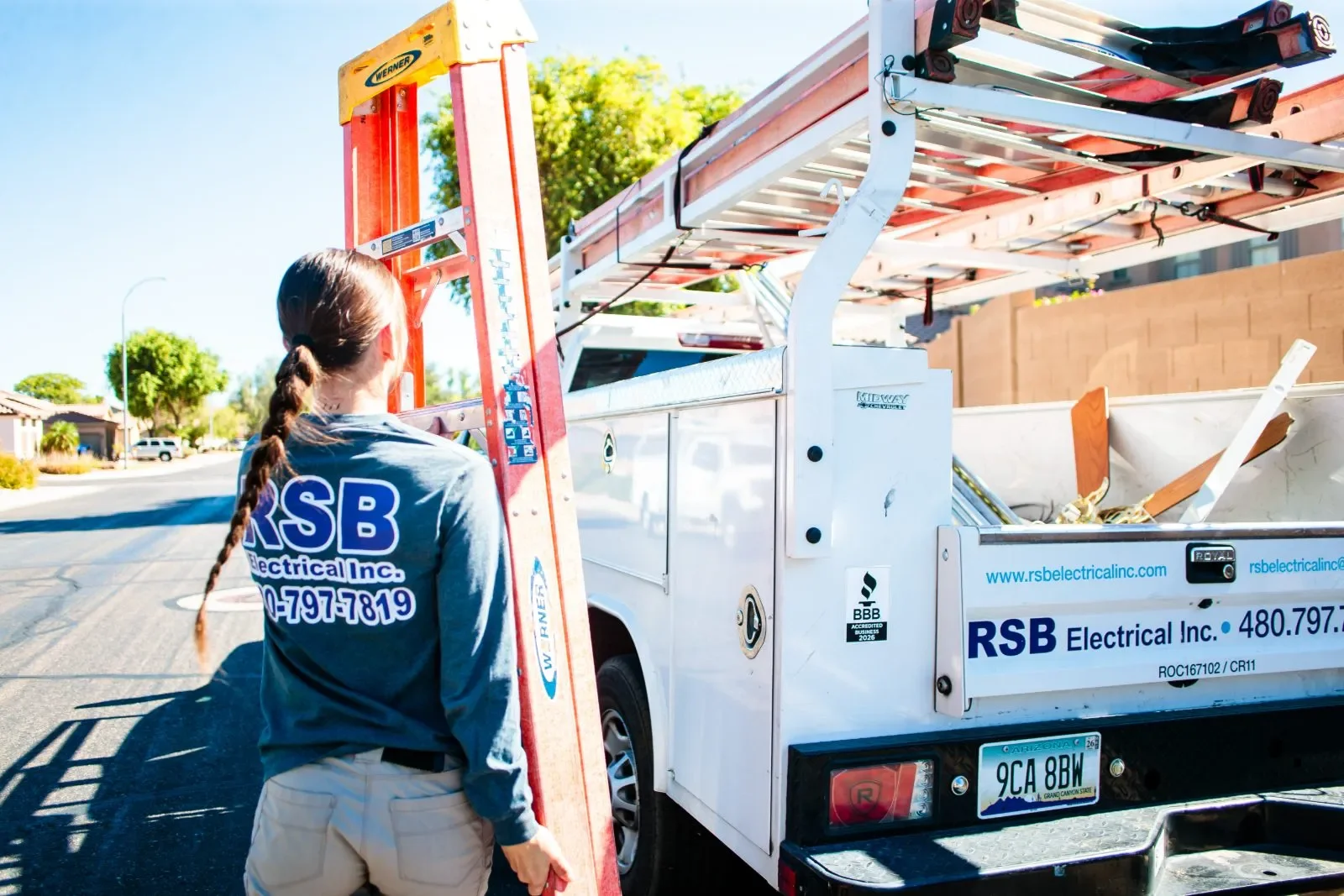
electrical repair Fountain Hills AZ RSB service truck
Home Service Areas Fountain Hills Electrical Repair
AZ ROC License #167102 (CR-11) Family-Owned & Operated Since 2001 Available 24/7 Free Estimates Licensed & Insured Highly Rated on Google

Electrical Repair in Fountain Hills, AZ

Repaired, or Replaced | AZ ROC License #167102 (CR-11) | Family-Owned Since 2001 | Free Estimates

Here is a distinction the trade uses constantly and almost never explains. We repair the wiring in a house. We replace nearly everything attached to it. There are good reasons for that, and nobody tells you what they are.

Knowing which is which changes what you should expect from a visit. It is the difference between finding a fault and swapping a part in the hope that the fault was the one.

2001 family-owned & operatedCR-11 licensed & insured30-day written quote honored
Free estimates Diagnosis before any part is fitted 1-year warranty on labor & materials
The Distinction

We Repair Wire. We Replace Most Devices.

A conductor is a simple thing. It fails in a small number of ways, nearly always at a connection and rarely along its length. So we cut out a damaged section and make it good in an accessible box. We remake a poor termination. That is genuine repair, and it is most of what this trade actually does.

Devices are a different proposition. A receptacle, a switch, a breaker, a GFCI: each one is a sealed or half-sealed assembly of moving contacts and springs, made to be fitted and not opened. Nobody designed them to come apart and go back together. Fit a new one, and you know what you have. Take an old one apart, and you do not.

This changes the shape of an honest visit. Where the fault sits in the wiring, we diagnose, and then we repair. Where it sits in a device, we still have to diagnose it. Fitting the new part afterward is the easy half. Anybody who opens with the new part has skipped the half that mattered.

Component by Component

What We Do With Each Thing When It Fails

Five components and one thing that is not a component, what failure looks like in each, and whether we have any option short of fitting new.

Receptacles: replaced, and worth replacing before they fail

Contacts wear. A plug that no longer grips, that falls out under the weight of its own cord, or that produces a warm plate is a receptacle at the end of its life, and there is nothing to adjust. They are quick to change, and the failure mode of leaving one is heat at a loose contact.

Switches: replaced, and the noise is the tell

A switch that has started to feel gritty, that needs a second push, or that buzzes is telling you its contacts are pitting. There is nothing inside to service. The exception is a buzzing dimmer, which is often the lamps talking through it; swapping it for an identical one teaches you that the slow way.

Breakers: usually replaced, and not reset past a real fault

A breaker is a mechanical device with a limited number of operations in it, and one that has interrupted a genuine short circuit has done something violent internally. It may well close again and look ordinary. Whether it will still open correctly next time is the question you do not want to be asking. So we treat a breaker that has cleared a serious fault as suspect. We inspect it, and we fit a new one unless there is a clear reason not to. A breaker that will not hold is a breaker we diagnose first and change second. Nobody repairs one into holding.

GFCI and AFCI devices: replaced, and the failure is a quiet one

These have a finite service life, and the important thing is that older ones can reach the end of it while still resetting perfectly happily, which is why the test button exists. A device that no longer trips on test is not protecting anything, whatever else it appears to be doing. Test them; the button is there to be used. A device that will not reset is telling you something, though not always that it has failed. The most common reasons are a fault still present downstream, no power reaching its line side, or line and load reversed at some point in its life. We rule those three out first. Only then is it a device to change.

Fixtures and their drivers: sometimes repaired, more often replaced

A fixture with a replaceable driver or ballast can genuinely be repaired, and where it is one you like or one that matches five others, that is the sensible answer. Integrated units with the electronics molded in are a replacement whether anybody likes it or not.

Terminations everywhere: repaired, and this is where the work is

Loose, corroded, over-torqued, backstabbed, or made up in aluminum without the right connector. Not one of these is a component failure. Every one of them is a repair. They are also the largest category of what we actually find, which is why a visit that goes straight to swapping a device is the wrong visit.

How the Work Goes

Where We Actually Make the Call

It starts on the phone, and the questions are not the obvious ones

Not what is broken. What it does, on what, at what time of day, and what changed before it started. A fault that only shows in the afternoon and one that only shows under load are two different jobs.

We reproduce the symptom before we judge anything

A fault described to us and a fault reproduced in front of us are different pieces of evidence. Some will not come out for a look. Where one refuses, we say so, and we say what that limits.

We sort every component in the chain into one of three piles

Serviceable, replaceable, and not ours to decide. A relaxed termination is serviceable. A scorched receptacle is replaceable. A meter enclosure belongs to somebody else, and we report it. That sorting is most of the job. It happens with the covers off.

We argue for a replacement. We do not assume one

The case for replacing a component is one of three things: it has failed, it cannot be put back into serviceable condition, or whatever damaged it is still there and will damage it again. Where none applies, the part stays, and we tell you why. Where one applies, we tell you which.

We de-energize anything that looks hazardous before going further

Where a permanent repair has to wait on a part, we isolate the circuit or device and label it. Then we tell you what is off and what that means for the rest of your day. We do not write an isolated circuit up as a finished repair.

You get a document, including the things we chose not to touch

What we found, what we repaired, what we replaced, and why; and the things we noticed and left alone, with our reasons for leaving them. That last list is the one people find useful a year later. One year on labor and materials on our work.

Who You Get

Who Makes This Call

The repair-or-replace call has one owner

It is Reno’s, and he gives it straight, including on days when the straight answer is that he does not yet know and intends to find out before anything is fitted.

⚡ Fountain Hills Electrical Repair FAQs

What People Ask Before Booking a Repair

1.Can the outlet be repaired at all?

There is nothing serviceable inside one. The contacts have worn, and there is no adjustment in them. Fitting a new one is the repair. What is worth insisting on is that whoever comes out establishes why it failed. A receptacle that has cooked itself usually had help from a loose termination behind it, and changing the face without addressing that puts a new part on an old problem.

2.My breaker tripped once during a storm and has been fine since.

That may be the device doing its job, and it may not, and the difference is not visible from where you are standing. What we would want to know is whether it interrupted a genuine short circuit or simply an overload, because those are very different events for the breaker itself. If it went with a bang, if anything smells, or if it has become reluctant to hold since, stop resetting it and have it looked at.

3.How do I know if my GFCI still works?

Press the test button. It should trip, and the reset should bring it back. A device that fails that test has to be changed. Monthly is the usual advice, and almost nobody manages monthly; twice a year is a great deal better than never.

4.My outlet was replaced last year, and the trouble is back.

Then the device was the symptom and something else was the cause, which is the most common reason a repair does not hold. Usually the termination behind it, or something upstream on the same circuit. Whoever comes next should arrive to diagnose rather than to fit another one.

5.Do you carry the parts?

The common devices, yes, and a good many repair visits need only the one. Fixtures, anything that has to match what is already on the wall, and discontinued equipment are the exceptions, and where a second visit is needed we tell you at the time, which is better than you finding out when nobody comes back.

Fountain Hills electrical repair — RSB Electrical

Something not working?

Tell us the symptom, the circuit, and what changed. The estimate is free.

Call (480) 485-4284

The Part Number Is Our Problem, Not Yours

Tell us the symptom, the circuit, and what changed. Those three answers open every repair call we take, and a Fountain Hills address is one we take them at. Which component we end up changing is a question for after the diagnosis and not before it, and a visit that begins with a part number has begun in the wrong place. The estimate is free.

Because electrical work is not just about making something work. It is about making sure it is safe, code-compliant, and reliable years from now.

Proof

What Fountain Hills Customers Say

Our Google listing is not curated, and there is no testimonials page. The live feed below is the whole record, good and bad, which is the only version worth reading.