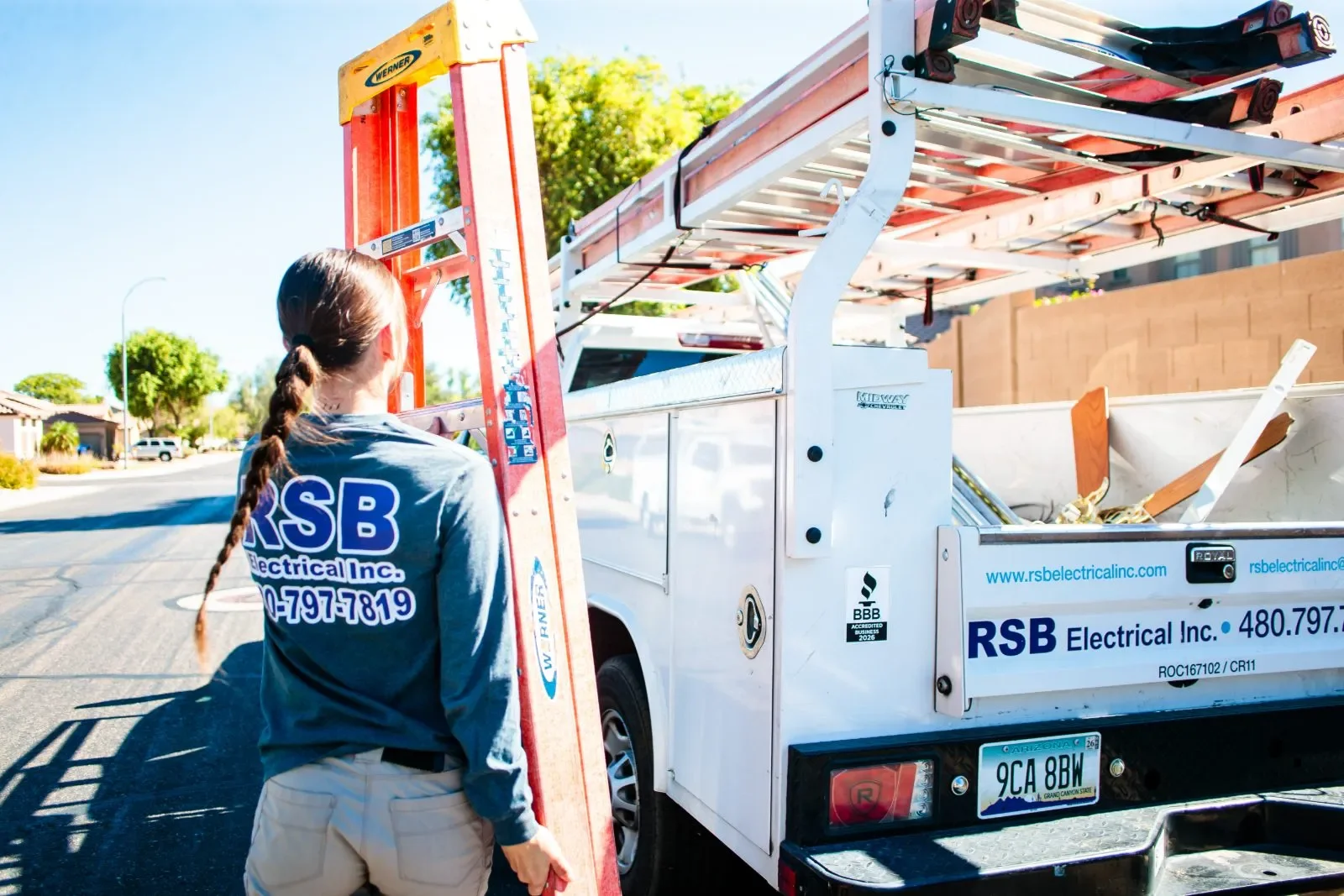
EV charger installation Maricopa AZ RSB service truck
Home Service Areas Maricopa EV Charger Installation
AZ ROC License #167102 (CR-11) Family-Owned & Operated Since 2001 Available 24/7 Free Estimates Licensed & Insured Highly Rated on Google

EV Charger Installation in Maricopa, AZ

Including the One That Came With the House | AZ ROC License #167102 (CR-11) | Family-Owned Since 2001 | Free Estimates

You bought the house, and the charger came with it. It was on the wall at the walkthrough; nobody in the transaction mentioned it, and no paperwork exists anywhere you can find it.

So what can anybody establish about it, in what order, and how much of that can you do yourself this afternoon?

Since 2001 family-owned & operated CR-11 licensed & insured 1-yr labor & materials warranty
Free estimates Written quote, honored 30 days 1-year warranty on labor & materials
What You Actually Inherited

Two Things, and Only One of Them Is Visible

What you can see is a piece of listed equipment on a wall. The unit is the part that is best known: a manufactured product with its own protection and instructions. What nobody handed you is any record of what sits behind it.

What you cannot see is the circuit behind it, and that is the entire question. Conductor size against the breaker. Whether that breaker matches the unit's draw. How the terminations were made, and whether anybody torqued them. Whether it runs off a receptacle that should carry ground-fault protection and does not. Whether it went into a panel with room, or squeezed into one without.

None of it is visible, and nobody can guess it from outside. So the sequence starts with what you can gather without tools and ends with a meter. A fair number of inherited installations turn out to have been done properly, and the check ends with readings and nothing to act on. Others do not. Which one you have is not knowable until the circuit has been read.

The Sequence

Six Checks, in the Order They Are Worth Doing

The first three need nothing but your own time. The last three end somewhere a homeowner should not: with a meter, the cover off, or both.

Find the model number and look up what it is

On a label at the side or underneath. You want its maximum rated output and whether it is hardwired or plugged in. Then the thing people miss: most units are adjustable, and the installer sets a working current at commissioning, often well below the number on the label. The label gives you the ceiling, not the setting.

Find the breaker that feeds it, and read what it says

In the panel, and it should be labeled. Note the number on the handle. If the schedule does not mention a charger at all, that on its own tells you something. It means somebody added a circuit and never updated the door, and that is rarely the only step they skipped.

Compare the two numbers

The output the unit is actually set to, and the breaker rating. A continuous load wants a circuit sized above it with margin, so a unit set to draw 40 amps belongs behind a 50-amp breaker. Where the set current is comfortably inside the breaker, that pairing is at least coherent. Where the set current is at or above the breaker rating, stop using it until we have read it. If you cannot find what the unit is set to, say so; do not assume the label figure is the working one.

Get the conductor sized and the terminations read

This is where our meter comes in. The conductor has to suit the breaker, the length, and the ambient it runs through. Both terminations have to be read under load. That takes a meter. This is the check that finds the problems that actually burn.

Establish how it is connected and what that requires

Whether it is plugged into a receptacle or wired in is visible from the doorway. Everything that follows from that answer is not. If it is on a receptacle, the circuit is subject to a ground-fault protection requirement. At the voltage and current a charger runs at, the practical way to meet it is a ground-fault breaker in the panel; the receptacle-mounted devices most people picture are made for ordinary 120-volt outlets. We also have to look properly at the receptacle itself, because a device nobody specified for hours of continuous duty is the classic inherited problem.

Check what it did to the rest of the panel

Whether that circuit went in within what the panel's label permits. Whether anything moved or doubled up to make room. Whether the service has headroom for the load at all. A charger squeezed into a full panel is a common finding, and the charger is not the part that is wrong.

How the Work Goes

And If You Are Starting From Nothing

A new charger circuit is the shorter job of the two

Reading somebody else's work is the harder half. A circuit put in from scratch leaves nothing to infer. We size it against the output you intend to run rather than the maximum the unit could reach, and we agree that number with you before ordering.

The panel decides most of it

Whether there is a position for the breaker, whether the label permits what goes in it, and whether the service has headroom for a continuous load on top of what the house already draws. That is a load calculation, and it comes before a date.

Then the route, the length, and the ambient

Where the unit is going, how far that is from the panel, and what the cable passes through. A run through an attic in July is not the same run in February, and the conductor is sized for the worst of the two.

The last step is a reading, not a handshake

We set the working current, run the unit with your car drawing, and read both terminations warm. The set current goes in writing, which is the paper the next owner of this house will wish the last one had kept. One year on labor and materials on our work.

⚡ Maricopa EV Charger Installation FAQs

What New Owners Ask Us First

1.What does an assessment visit involve?

You read us two numbers off the wall and the panel first, so the visit starts on a question instead of an inventory. Then we read the circuit with your car actually drawing on it: voltage under load, both terminations while they are warm, and the conductor confirmed against the breaker, the run, and the ambient. Most of a short visit is spent on two ends of one cable.

2.What do I end up with?

A written result either way: what the unit is, what the circuit is, what we checked and measured, and what we corrected. Where something has to be put right, the list comes with reasons, split into what stops you using the unit now and what can wait. Running those two together is how people end up doing everything at once or nothing at all.

3.It has been working fine. Is this really necessary?

Working is not the same as verified, and the specific failure this check is designed to detect is a termination heating under sustained load, which works perfectly until it does not. That said, comparing the unit's output against the breaker rating is worth doing today, because that comparison can tell you to stop. What it cannot do is clear the installation: the conductor, the terminations, and the ground-fault arrangement are not visible from where you are standing.

4.The seller said an electrician installed it.

Quite possibly true, and it does not change the checks. Paperwork would: an invoice, a dated photograph of the panel, an installer's name. Any of those turns an investigation into a confirmation, and they are worth a proper look. Where none exists, the checks run the same way; the paperwork shortens the reading without replacing it.

5.Can I just have it removed?

Yes, and it is a short job. Removing the unit does not remove the circuit, though. A circuit left behind comes off its breaker, and we cap and mark it. The version to avoid is one still landed on a live breaker with nothing on the far end. If you might ever want a charger again, correcting the circuit and leaving it in place is usually the better answer.

6.What if it turns out the circuit is wrong?

Then you find out what it would take to make it right, and you decide. Most of what we find is correctable without disturbing the wall: a breaker of the wrong size, a termination to remake, a missing ground-fault device. The awkward version is a conductor genuinely undersized for its run, and that one matters either way.

7.Does it matter which car I have?

For this purpose, only in that the car sets what the unit actually has to deliver. A unit capable of 48 amps, set to 40, feeding a car that pulls 32 amps is working well on both counts. The readings come from what the circuit actually carries with your car on it, which is the number that matters and the one nobody can get off a label. Tell us the car; it changes what the numbers mean.

Maricopa EV charger installation - RSB Electrical

Bought a house with a charger?

Read us two numbers off the wall and the panel, and the conversation starts there.

Call (480) 485-4284

Start With Two Numbers and a Car

You bought a piece of equipment and have no history for it. That is an uncomfortable position and a very ordinary one. What we can do is turn it into a documented one: a circuit read under load, a set of numbers written down, and a clear statement of what is right and what is not. Bring us whatever the unit is set to, or its label rating if the setting is not findable, plus the number on the breaker feeding it. Whatever part of Maricopa the house is in sets the tone for the conversation before we come out. The estimate is free, and the written quote arrives the next day and is valid for 30 days.

Because electrical work is not just about making something work. It is about making sure it is safe, code-compliant, and reliable years from now.

Proof

What Maricopa Customers Say

Our Google listing is not curated, and there is no testimonials page. The live feed below is the whole record, good and bad, which is the only version worth reading.