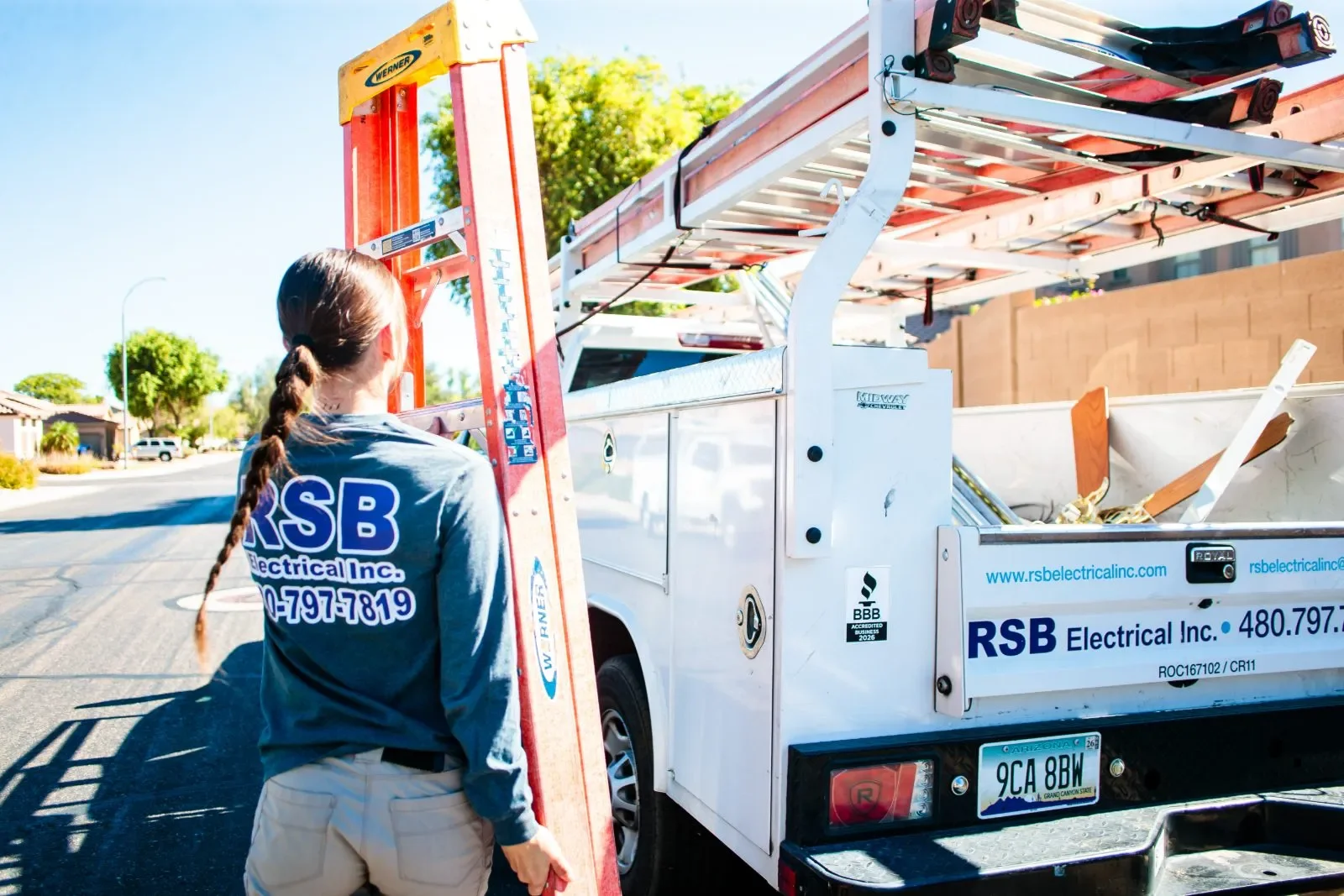
24-hour emergency electrician Fountain Hills AZ RSB service truck
Home Service Areas Fountain Hills Emergency Electrician
AZ ROC License #167102 (CR-11) Family-Owned & Operated Since 2001 Available 24/7 Free Estimates Licensed & Insured Highly Rated on Google

24-Hour Emergency Electrician in Fountain Hills, AZ

What the Noise Usually Means | AZ ROC License #167102 (CR-11) | Family-Owned Since 2001 | Available 24/7

At two in the morning, in a room you cannot see properly, sound is the only evidence you can gather without touching anything. That makes it worth more here than it is at any other hour.

Nine sounds a house makes at night. Two of them mean one thing: switch that circuit off. For the other seven, what is happening alongside the noise decides most of it, and that difference is worth knowing before you decide whether to call. The number a Fountain Hills caller uses at midnight is the same as the one they use at noon.

24/7 on-call electrician answersCR-11 licensed & insuredFree estimates
A real electrician answers 24/7 Free triage on the phone After-hours rate quoted first
The Two That Don’t Wait

Two Sounds That End the Reading

A frying or sizzling noise, and a sharp crack or snap. Either of those, at a device, a switch, an outlet, or the panel, means the same thing. Go to the panel. Switch that circuit off if the panel is within reach. Leave it off. Then call. Do not open anything and do not put your hand near it.

Both of those are consistent with an arc, and an arc makes its own heat without necessarily drawing the current an overcurrent device is watching for. An ordinary breaker responds to the amount flowing. An arc across a poor connection can burn happily at a current that the breaker is entirely comfortable with. Arc-fault devices exist precisely because of that gap, and not every circuit has one.

With neither of those present, and nothing in the house warm, discolored, or smelling of burning, the rest sorts by what else is happening at the same time. If any of that changes, the answer changes with it.

Seven Sounds

What a House Sounds Like When Something Is Wrong

Seven noises, roughly in the order of how fast each has to be dealt with. Most you can place by listening and noting when they happen. Three of them ask you to touch something, and each says so.

A steady buzz or hum from the panel itself

Equipment carrying current can make a low noise. People stop hearing their own house within a week of moving in, and a quiet night puts it back in front of them. A hum that has changed is the clearest signal: louder than before, or arriving where there was none. One you can feel through the cover as vibration matters more still. If you cannot tell whether it is new, say so, and we will treat it as new. A breaker not fully seated on the bus, a lug starting to arc, or noise carried in from equipment elsewhere all present this way. Note whether it changes when a large load switches on.

A buzz from a dimmer or a switch

Common, and generally the load talking rather than the switch. Certain lamps and certain dimmers make each other buzz. The version that matters is a buzz that is new on a dimmer that was quiet with the same lamps, or one you can feel as warmth through the plate. Warmth moves it into the switch-it-off category.

A hum or growl from a light fixture or a fan

Ordinarily, the ballast or driver inside the fixture, and the fixture, can be replaced. A failing driver and a loose connection in the ceiling can sound much the same from the doorway, and one of those is a fixture, and the other is the wiring. If more than one fixture on the same circuit has started doing it, say so.

A click or clack that repeats every few seconds

Something is trying to start and failing, over and over. Air conditioning contactors do this, as do refrigerator and pool equipment relays. Two things produce it, and they have to be told apart: a relay or contactor doing its ordinary job, and a motor or a connection that has started to struggle. The repetition is hard on the circuit either way. Tell us what is in that direction of the house.

A hum you can hear from outside near the meter

Equipment on the supply side makes noise of its own, and separating that from something on your side of the meter is part of the visit. Two things move it up: a hum that starts at the same moment your lights change brightness, and a hum accompanied by anything visible at the mast or the drop. Neither is something to approach. Note the time and call.

A short chirp every thirty to sixty seconds

Almost always a smoke or carbon monoxide alarm: a failing battery, or a unit at the end of its life. At three in the morning, people reliably think it is the house. Identify which unit it is before you call anybody. The date is printed on the back, which does mean taking it off its base.

A sound that stops when you are listening for it

Genuinely common, and not a reason to disbelieve yourself. Note the room, the time of night, and what was running. A sound that only occurs in one part of the air conditioning cycle is a gift. It means we can reproduce the fault on demand instead of waiting for it.

⚡ Fountain Hills Emergency Electrician FAQs

What Callers Ask Us After Hours

1.The panel hums. Has it always done that?

Possibly, and that is the useful question. What matters is change: louder, different in pitch, new since a particular week, or something you can feel through the cover. Tell us how long you have lived there. A hum you never noticed and a hum that started in June are different calls.

2.I can hear buzzing in the wall, but everything works.

Say where it is, because that changes the answer. A buzz at a device, warmth at any plate on the circuit, or lights on it misbehaving are tonight’s questions. A buzz inside a wall with nothing else happening is one to describe and let us place. Otherwise, switch the circuit off if you would rather not leave it energized overnight, and book a daytime visit.

3.Something crackled and then stopped. Is it over?

No, and this is the one people talk themselves out of. An arc that has stopped has usually stopped because something moved, opened or burned away, and all three of those leave the situation worse than they found it. Switch that circuit off and call.

4.My air conditioner clicks repeatedly but never starts.

Switch it off at the thermostat and at its own disconnect if you can do so safely, then call. Repeated start attempts are hard on the compressor and on the circuit. Which of the two it is is what the visit establishes. Where it turns out to be mechanical, you get told that, and you get the readings, so the next person is not starting from nothing.

5.Can I record it and send it?

Yes, and it helps more than people expect. Hold the phone still, get as close as is safe without touching anything, and say out loud in the recording where you are standing and what is running. A ten-second clip with that narration is better evidence than a paragraph of description.

Fountain Hills emergency electrician on call at night — RSB Electrical

Something wrong right now?

A real electrician answers 24/7, with free triage on the phone before anyone is dispatched.

Call (480) 485-4284
How the Work Goes

What Two Minutes on the Phone Settles

What you are asked before anything else

Frying, sizzling, cracking or snapping, and anything warm or discolored. Heat, smell, and visible arcing come first, because a yes to any of them changes what we tell you to do next.

Where the sound is, and what it is near

The room, the height, whether it is at a device or in the wall, and what large equipment sits in that direction. A hum with a location is a different problem from a hum without one.

When it happens, and what else is happening then

Continuous, intermittent, or tied to something switching on. This is the question that produces the answer more than any other, and it is one only you can answer.

What is off, if anything

A sound with no loss of power is a different call from a sound with a dead circuit behind it. Both are worth making; they are not the same urgency.

Whether it can wait for daylight

Some can, and we will say which. An after-hours rate applies evenings and weekends. You hear it on the call and you agree to it before anything is booked.

What Happens When You Call

What Happens When You Call After Five

What happens to the call itself

The out-of-hours phone does not divert to a call center. It reaches whoever is holding it, most often Reno. The first two minutes go on the noise: where it is, what kind it is, whether anything is warm. Plenty of calls settle inside those two minutes, in both directions.

Why we ask about sound before anything else

Because at that hour it is what you have, and it is also the evidence most likely to be wrong on its own. That is why the call ends with what to do rather than with a diagnosis.

Four Things to Have Ready When You Call

Start with where the sound is and what kind it is. Then when it happens, and what else is running at the same time. Given those, we can usually tell you on the phone whether to act now or to book. One exception. If the noise is frying, sizzling, cracking, or snapping, the breaker comes off before the phone comes out. Whatever it turns out to be, you get it in writing afterward, plainly enough to still be useful to you next winter, with one year on labor and materials on our work.

Because electrical work is not just about making something work. It is about making sure it is safe, code-compliant, and reliable years from now.

Proof

What Fountain Hills Customers Say

Our Google listing is not curated, and there is no testimonials page. The live feed below is the whole record, good and bad, which is the only version worth reading.