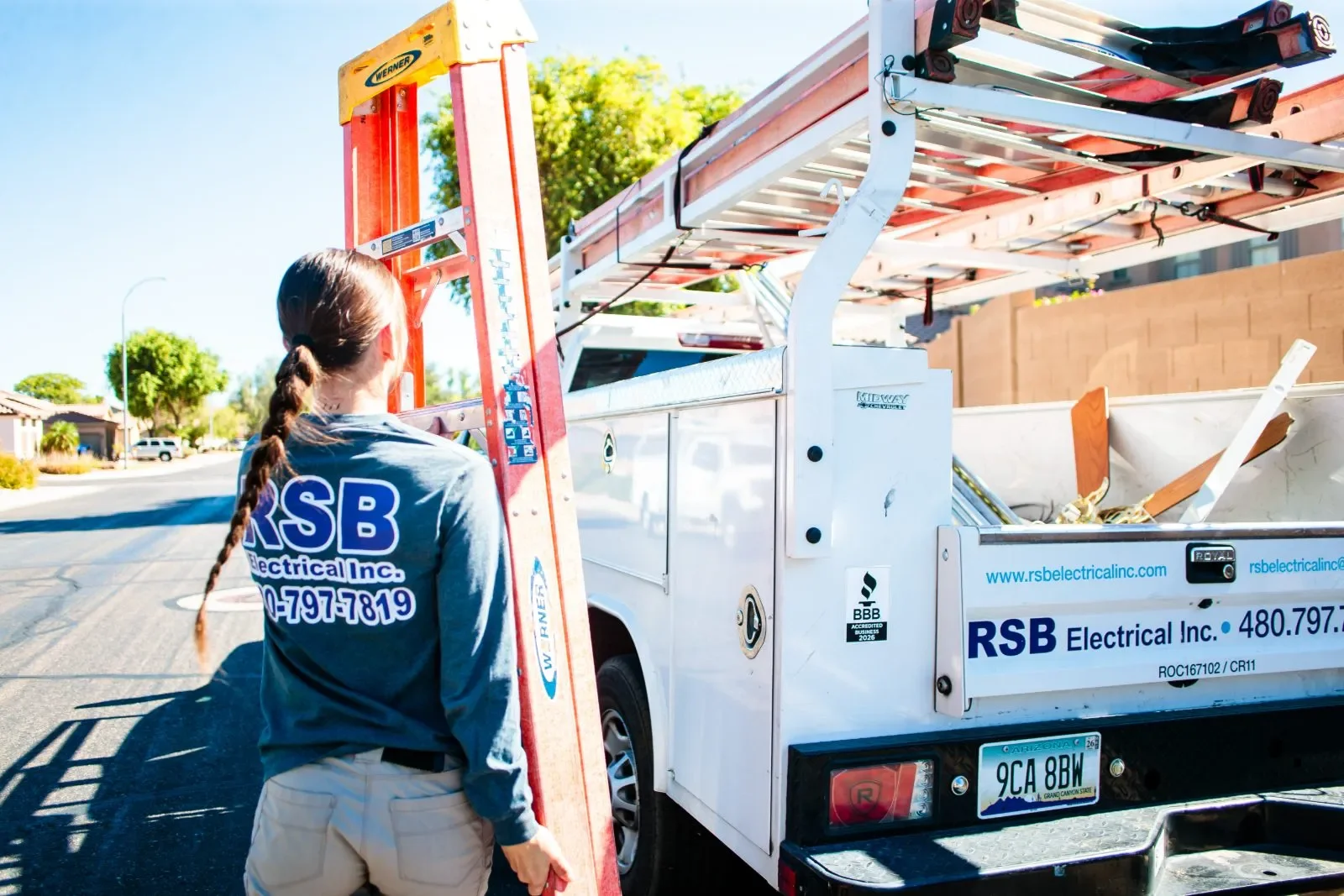
EV charger installation Ahwatukee AZ — RSB Electrical service truck
Home Service Areas Ahwatukee EV Charger Installation
AZ ROC License #167102 (CR-11)Family-Owned & Operated Since 2001Available 24/7Free EstimatesLicensed & InsuredHighly Rated on Google

EV Charger Installation in Ahwatukee, AZ

Three Ceilings, and the Lowest One Wins | AZ ROC License #167102 (CR-11) | Family-Owned Since 2001 | Free Estimates

People shop for a charger the way they shop for a hose, on the assumption that a bigger one fills the tank faster. Sometimes it does. On a great many houses the charger on the wall could deliver twice what the car will accept, and the second half of it never leaves the box.

There are three separate ceilings on how fast a car charges at home, and the slowest of the three sets the speed. Only one of them is the charger. Anybody in Ahwatukee about to buy one is better off having this conversation first, because the lowest of the three ceilings is usually the one you cannot buy your way past.

2001 family-owned since1 yr warranty on our workCR-11 licensed & insured
Set to your car's real limit Conduit sized with room to grow Commissioned with your car drawing
The Three Ceilings

The Car, the Circuit, and the Unit on the Wall

The first ceiling is inside the car. Every electric vehicle carries its own equipment to convert the alternating current from your house into the direct current its battery uses, and that equipment has a fixed limit. Whatever the wall unit is capable of, the car will accept up to its own figure and not one amp beyond it. On a good many vehicles that figure is well under what a modern charger can supply.

The circuit sets the second one. A charger is a continuous load, so the circuit is sized above the draw with margin, and the unit's working current is set at commissioning to fit inside what the circuit and the panel can carry. Somebody chooses that number on the day. It is not a property of the box.

Last comes the unit on the wall, which is the only one of the three anybody shops for. It matters only when it is the lowest. Where the car accepts less than the circuit could deliver, a larger unit changes nothing you will ever notice, and the installation is where the attention belongs instead.

What to Establish First

Six Things That Decide the Answer, and the Order to Ask Them In

You can answer the first two this afternoon without anybody coming out. The rest need somebody at the panel.

Your car has a fixed AC limit, and it caps everything else

The figure is in the owner's manual and on the manufacturer's specification page, usually given in kilowatts. It is the one number nobody looks up. If you are choosing between two cars, know it before you choose the charger.

Whether you will keep that car for the life of the installation

A circuit outlives a vehicle. Where the car you have accepts less than the circuit could give it, there is a reasonable argument for sizing the circuit for the car after next and setting the unit lower for now. That is a decision about conduit and conductor, and it is much easier to make before the wall is closed than after.

How long the car actually sits at home

A vehicle plugged in from evening until morning has a great many hours in hand. Where the arithmetic shows that even a modest setting refills what you drive in a day, the case for a larger circuit weakens considerably, and that sum is easier to do now than to argue about later.

What the panel has room for

Positions first, then capacity. A charger circuit needs somewhere to land, and the service needs headroom for a sustained load on top of what the house already draws. Those are two separate questions, and a load calculation answers the second.

Distance and heat between the panel and the wall

Length shows up twice, in conductor size and again in voltage drop, and we work both out rather than estimating them. Heat counts for as much as distance. A conductor crossing a roof space in an Arizona summer gets derated for the air around it, not for the air in a test lab.

Whether it is hardwired or on a receptacle

Settled last, because everything before it changes the answer. A receptacle-fed unit brings a ground-fault protection requirement with it, and at the voltage and current a charger runs at, the practical way to meet that is a device in the panel.

How the Work Goes

How the Install Runs

We settle the working current before anything is ordered

Your car's limit, the panel's headroom, and what you want the unit set to are agreed as a number and written down. Everything after this follows from it, and changing it later means changing the conductor.

We size the circuit against that number, with margin

A continuous load requires a circuit above the draw, so a unit set to draw 40 amps belongs behind a 50-amp breaker. That agreed number, and not the label on the box, is what the conductor gets sized from.

We run it, and we leave room in the pipe

Where conduit is used, we size it for more than today's conductor. Room in the pipe at the time it goes in is the difference between pulling a larger conductor in six years and opening the wall a second time.

We commission it with your car on it

The unit set, the vehicle drawing, and both terminations read while they are warm. A charger that has never been run under load has not been tested, no matter what the label on the box says.

You get the set current in writing

Along with what the circuit is, what the conductor is, and what the panel had left afterward. One year on labor and materials on our work. Whatever terms the maker gives the unit came with the unit and not with the house.

Who You Get

Two People, Two Questions

Reno asks what you drive before he looks at the wall

In the trade since 1983, and unmoved by the size of the unit on the wall. The car sets the ceiling on most of these installations, so he starts there.

Sharee gets the two numbers on the phone

The car's onboard limit and what the panel has room for. Between them, they settle most of the question before anybody comes out.

⚡ Ahwatukee EV Charger Installation FAQs

What Drivers Ask Before Booking

1.Should I buy the biggest charger I can?

Only if the car can use it. A good many cannot. Where the vehicle's own limit is below what a smaller unit already delivers, the extra capability sits idle. The argument for buying larger is about the next car, and it is a real argument, but it belongs in the conductor and the conduit more than in the box on the wall.

2.My charger says it can do more than I am getting.

Three things could be limiting it, and only one of them is a fault. The car's own ceiling, the current the unit was set to at commissioning, and the circuit behind it. The first two are settled by reading numbers. Where those two do not explain the figure you are seeing, the circuit should be read under load, because a connection that is heating will also be restricting.

3.Does charging get slower as the battery fills?

On a home AC installation, much less than people expect. The pronounced tapering drivers notice belongs to high-power roadside charging. At home, the rate is close to flat for most of the session and then eases near the top. If yours slows sharply and early, mention it. That is a reading we would want to take.

4.Can I put it on the circuit the dryer uses?

Not in the ordinary sense, because a charging circuit supplies the charger and is not wired so that two ordinary loads can draw on it at once. There are recognized arrangements that appear to be exceptions, including a listed interlock that allows only one of the two to be energized at a time, and listed equipment that manages a shared total. Both are real options on some houses, and both are a different conversation.

5.What if I am not sure which car I am buying yet?

Then size the circuit for the higher of the figures you are considering and set the unit for whatever arrives. The conductor is the part you cannot change afterward without opening the wall, so it is the part to decide generously.

Ahwatukee EV charger installation — RSB Electrical

Planning a charger?

Look up your car's AC limit, then call — that one number shapes the whole install.

Call (480) 485-4284
Every Electrical Service in Ahwatukee

Everything Else We Cover in Ahwatukee

A charger is often the first hard question a garage has faced. Also from us here:

Look Up One Number Before You Call Anybody

Your car's AC charging limit, which is in the manual and on the maker's specification page. That single figure determines whether this is a conversation about the unit or the circuit. Bring it, plus a photograph of the panel with the door open, and most of the answer arrives before we do. The estimate is free, and the written quote arrives the next day and is valid for 30 days.

Because electrical work is not just about making something work. It is about making sure it is safe, code-compliant, and reliable years from now.

Proof

What Ahwatukee Customers Say

Our Google listing is not curated, and there is no testimonials page. The live feed below is the whole record, good and bad, which is the only version worth reading.