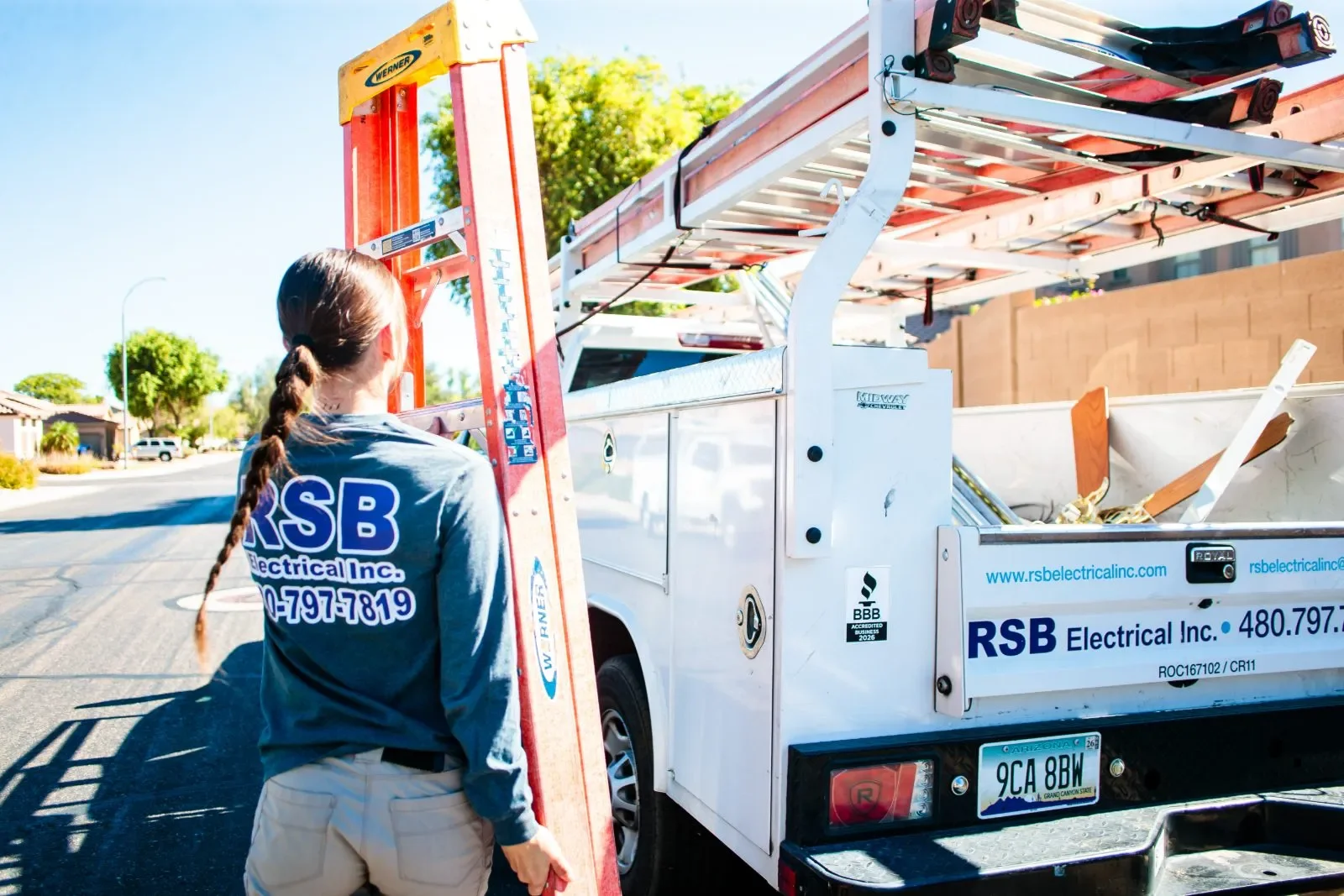
Electrical Panel Upgrades in San Tan Valley, AZ — RSB Electrical service truck
Home Service Areas San Tan Valley Electrical Panel Upgrades
AZ ROC License #167102 (CR-11)Family-Owned & Operated Since 2001Available 24/7Free EstimatesLicensed & InsuredHighly Rated on Google

Electrical Panel Upgrades in San Tan Valley, AZ

What It Fixes, and What It Will Not | AZ ROC License #167102 (CR-11) | Family-Owned Since 2001 | Free Estimates

A new panel is sold as a cure for a lot of things it has no effect on whatsoever. Flickering lights. A breaker that keeps going. A panel with no room left in it. On all three, the honest answer differs from the one people expect to hear, and on two of them, the answer is that a new panel changes nothing.

So before anything about sizes or amps, here is the sort. Two groups below: what a service change genuinely resolves and what remains when it is done. RSB has been swapping services for twenty-five years, and the estimate names which group your complaint belongs to.

25 yr swapping servicesCR-11 licensed & insured1983 Reno in the trade since
The complaint gets measured before anything is recommended You are told which list you are on, in writing One year on labor and materials
Where the Two Lists Came from

Why the Wrong Panel Job Gets Sold

Almost every complaint that brings somebody to a panel page starts downstream of the panel. A loose connection in a box, a circuit carrying more than it was built for, a device failing, a neutral shared between two circuits and coming adrift. The panel is the visible object at the end, so it gets blamed.

Replacing it in those cases produces a tidy new enclosure and the identical symptom. We have been called to exactly that: a service change done, the complaint unchanged, and the fault still sitting in a box twenty feet away.

The sort below did not come out of a manual. It came from which service changes ended the thing that prompted them and which ones did not, a distinction you only see if you are still around for the second call.

None of which makes panel upgrades unnecessary. There are real reasons to do one, which is exactly why the question is worth settling before the quote.

Two Lists

What a New Panel Actually Changes

The first group is what a service change genuinely resolves. The second is what will remain when it is done. If your complaint is in the second group and somebody has quoted you a panel for it, ask what they found.

Resolved: an enclosure out of room, where a subpanel will not do

A panel with no space for another breaker and none for tandems is a real constraint with two answers. Where the service behind it is adequate, a subpanel usually settles it without touching the incoming supply. Where the service is at its limit, too, or the equipment will not accept a subpanel feed, the larger enclosure is what is left, and it belongs on this list.

Resolved: a service genuinely at its limit

Where the load calculation says the incoming service cannot carry what the house already draws plus what you want to add. That is a supply problem, and it needs a bigger supply. The calculation establishes it, and it should arrive before the recommendation does.

Resolved: damage inside the enclosure

Corrosion, heat marks on the bus, breakers that no longer seat, a panel where water has been. These are conditions of the equipment itself, and replacement is the answer.

Resolved: bonding and grounding at the service, where it is scoped in

A service change is the natural moment to put the electrode system, the bonding jumper, and the electrode conductor right. It is not automatic: swapping an enclosure corrects none of those on its own, so it belongs on the written scope where you can see it.

Not resolved: flickering that comes and goes

Far more often, a connection somewhere downstream, and a connection downstream will flicker through a new panel as happily as through the old one. There is a version where the loose termination is inside the panel, on a lug or a breaker, and that one a service change does end. Which of the two you have is a measurement, and it is the measurement most often skipped.

Not resolved: one circuit that keeps tripping

Whether it trips because too much is on it or because something on it is faulty, moving the breaker into a new enclosure does not change either cause. Until someone finds what is on the circuit or what is wrong with it, the trip remains unexplained rather than addressed.

Not resolved: grounding out in the house

The service end and the branch circuits are separate questions. A two-wire circuit with no equipment ground in a back bedroom is exactly as ungrounded the day after, and no enclosure turns one into a grounded circuit.

Not resolved: voltage sag arriving from outside

Where the dip is coming in on the service conductors, a new panel changes nothing. Establishing that is a measurement worth taking before anybody quotes equipment.

San Tan Valley Conditions

No City Counter, and What That Leaves You

San Tan Valley had 99,894 residents at the 2020 census and has no city government of its own. Pinal County is the jurisdiction, as it is for any unincorporated area, and on most electrical work that is a piece of trivia.

On a panel, it is worth a moment, because a service change is the sort of thing people want to look up later. In an incorporated town that file sits with a municipal department. Here it is the county's, a step further from the street it describes, and in our experience almost nobody goes looking for it.

Which is why what leaves the house with you matters. At the end of a service change, the schedule inside the door gets rewritten legibly and photographed, and the photograph is yours. It will not tell you what rating the service was changed to, which is the county file's job. It will tell the next electrician what feeds what, which is the question they will be standing there asking.

How the Work Goes

How We Get to the Answer

The complaint gets tested

Whatever brought you here is measured first. A flicker gets loaded and watched, a tripping circuit gets its load counted, a warm panel gets read under load, and all of that comes before any conversation about sizes.

The cover comes off

Terminations, bus condition, breaker seating, the grounding and bonding as it stands, and what is on each circuit against what the schedule claims. Most of the answer is in here.

A load calculation, where the question is capacity

Every fixed load gets counted; the general lighting and receptacle load comes off the floor area, air conditioning and heating are compared and usually only the larger survives into the total, and the demand factors reduce what is left to something realistic. The heat-pump case where backup heat can run alongside the compressor is the exception, and there the two combine. The result is a floor under any service size anybody proposes.

You get told which list you are on

Including when the answer is that a panel changes nothing about your complaint and that the real work is elsewhere. That answer is given in writing, with what it was based on.

If it goes ahead, a date and a written scope

You get the outage window ahead of the day, and the scope in writing, including any grounding and bonding work that falls within it. At the end, the schedule on the door describes the house, in handwriting somebody else can read. The work is permitted and inspected. One year on labor and materials on our work.

Who You Get

The People on the Other End of This

Reno, who has never liked this job being oversold

In the trade since 1983. He will talk a customer out of a service change roughly as often as he sells one, and he would sooner lose the work than fit an enclosure that leaves the complaint where it was.

Sharee books the outage

The utility has to pull the power and restore it, and their window generally determines the day rather than our schedule. She arranges it and tells you what you have.

⚡ San Tan Valley Electrical Panel Upgrades FAQs

San Tan Valley Panel Upgrade Questions

1.My lights flicker. Will a new panel stop it?

Sometimes, and more often not. A flicker that comes and goes is usually a connection out in the house, and that one flickers just as well through new equipment. A loose lug or a poorly seated breaker inside the panel is the version a service change does end. Loading the circuit and reading it under load separates them in about twenty minutes.

2.Is 200 amps the right size?

Common, certainly. Automatic, no. The calculation decides differently for a house with gas cooking and heating than for one where everything runs on electricity. A workshop or a second structure changes it again.

3.Somebody quoted me a panel without opening it. Is that normal?

Common enough, and not good practice. The cover has to come off to see terminations, bus condition, and what is really on each circuit. A number produced from outside a closed box is an estimate of a job nobody has looked at.

Electrical service in San Tan Valley — RSB Electrical

Not sure a panel is the answer?

Bring us the symptom. If a new panel changes nothing about your complaint, you will hear that while the old one is still on the wall.

Call (480) 485-4284
Every Electrical Service in San Tan Valley

Everything Else We Cover in San Tan Valley

A panel is rarely the first thing in a house to go wrong. Everything else we handle:

Bring Us the Symptom and Let Us Find the Cause

Tell us what the house is actually doing and let the visit decide whether a panel is the answer. The complaint gets measured before anything is recommended, and if a new panel changes nothing about your problem, you will hear that while the old one is still on the wall. The estimate is free, and the written quote arrives the next day and is valid for 30 days.

Because electrical work is not just about making something work. It is about making sure it is safe, code-compliant, and reliable years from now.

Proof

What San Tan Valley Customers Say

Our Google listing is not curated, and there is no testimonials page. The live feed below is the whole record, good and bad, which is the only version worth reading.