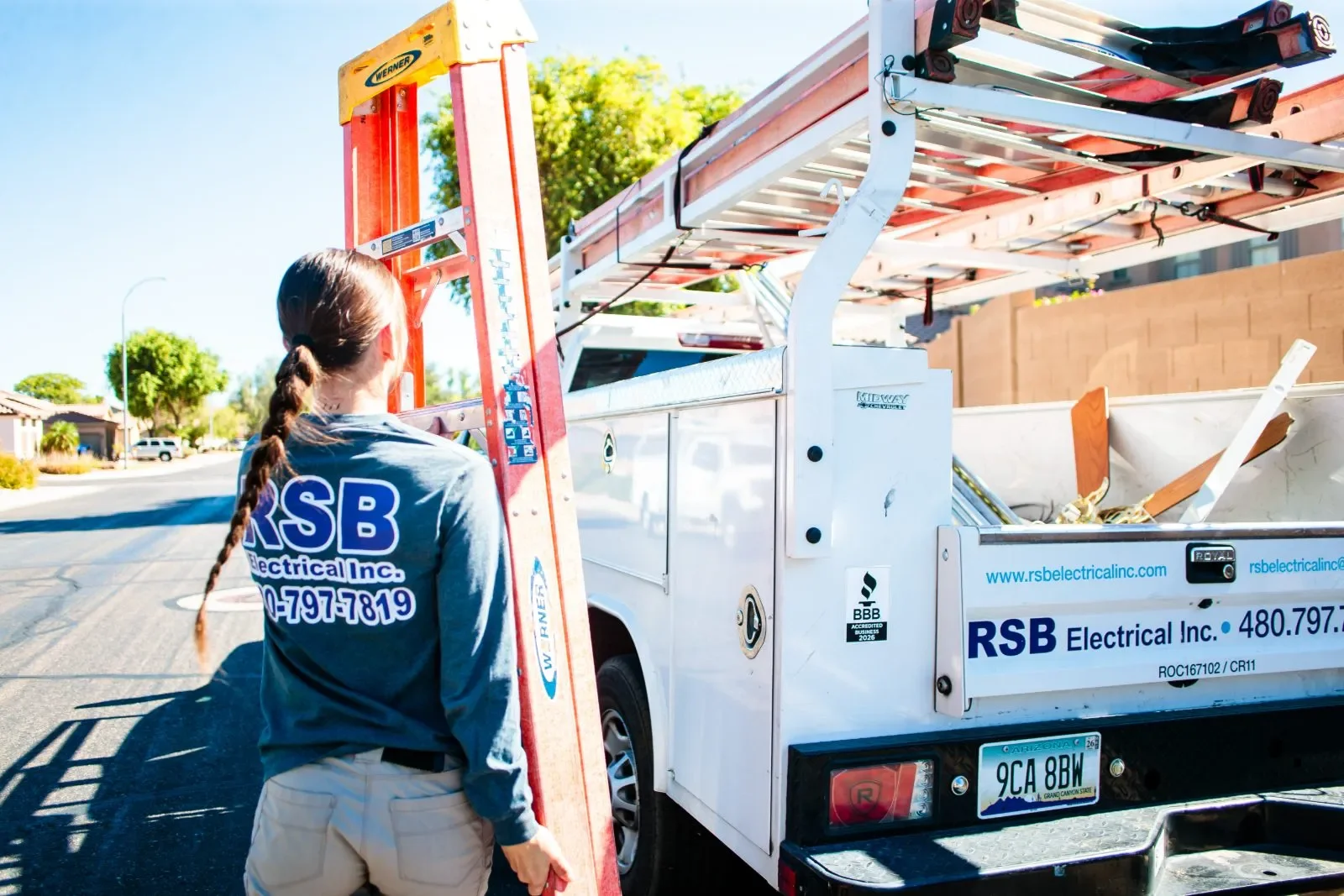
EV Charger Installation in San Tan Valley, AZ — RSB Electrical service truck
Home Service Areas San Tan Valley EV Charger Installation
AZ ROC License #167102 (CR-11)Family-Owned & Operated Since 2001Available 24/7Free EstimatesLicensed & InsuredHighly Rated on Google

EV Charger Installation in San Tan Valley, AZ

The Longest Load Your House Has Carried | AZ ROC License #167102 (CR-11) | Family-Owned Since 2001 | Free Estimates

Fitting the charger is usually uneventful. What is worth knowing beforehand is that a car charging overnight is one of the longest sustained electrical loads a house carries, and loads like that find things.

Most large loads in a house are intermittent by design. A cooktop element cycles on a thermostat. A water heater comes on, recovers, and shuts down. A compressor starts and stops all evening. Charging behaves differently: the current is set once and then simply held, for as long as the car will take it, and anything in the path that has been quietly getting worse tends to declare itself in the first few weeks.

CR-11 licensed & insured2001 family-owned since1983 Reno in the trade since
The panel gets read before the circuit is designed Terminations torqued to the equipment figure One year on labor and materials
What the Circuit Finds

Four Things a Charging Circuit Turns Up, and One It Gets Blamed For

Not on every house, and none of it is a reason to leave the car on a wall outlet. It is the reason a charger estimate here starts with the cover off, and the reason the first month is worth paying attention to.

A termination that has never had to hold heat this long

Connections loosen over years, and under intermittent loads they cool between bouts. A charge session removes the cooling. A lug at the main, a breaker that was never torqued, a backstab on a shared circuit: sustained current gives all of them the chance an oven never does.

A service that is adequate on paper and busy in July

The calculation uses assumed demand factors, and it is the right tool. What it cannot see is your particular August evening with the cooling running flat out, the oven on and the car drawing forty amps. Where those stack, the answer is usually to move the charge later or set the output lower, and neither of those is a compromise worth being precious about.

A main nobody has actually measured

Charging is the load that finally asks the service a direct question. Reading the main at full evening draw with the charger on gives a measurement rather than a calculation, and the two do not always agree.

A circuit directory that stopped being true

Adding a circuit means the door has to describe the house, and on most houses it has not for years. Tracing what feeds the garage regularly turns up a shared neutral, an abandoned run still live, or two rooms on a breaker labeled for one.

And the one it gets blamed for: the neutral

A charging circuit is a balanced 240-volt load with no neutral conductor doing any work, so it adds nothing to the neutral. A neutral problem that surfaced while the panel was open was there beforehand, and it has to be dealt with on its own account rather than written off as the charger's doing.

Why This Load is Different

Sustained Is the Word That Matters

Design practice draws a line at three hours. At or beyond it, a load is considered continuous, and the conductor and the overcurrent device are both sized with a margin above the actual draw, on the grounds that heat accumulates when nothing gets a rest. That margin is the reason a charging circuit is always specified larger than the number on the charger.

The same logic applies to everything the current passes through, and that part is not in the specification. A conductor is sized off a table. A termination on that conductor is only as good as the last person who tightened it, and heat is patient.

Which is the reason the estimate starts at the panel and not at the parking space. It is the longest part of the visit, and it is where the useful information is.

It is also why two houses on the same street can want the same unit and produce two different workdays. Where the panel sits relative to where you park, what the main has been carrying on a July evening, whether the directory on the door still describes the house: none of that is visible from outside, and all of it changes the job.

⚡ San Tan Valley EV Charger Installation FAQs

San Tan Valley EV Charging Questions

1.Should the unit be plugged in or wired in?

Both are ordinary, and one detail decides it more often than people expect. A charger fed from a receptacle sits on a circuit that must carry ground-fault protection for people, usually provided by the breaker; hardwire the same unit, and that particular requirement does not apply, because it attaches to the receptacle. The equipment's own leakage detection is not a substitute, since it operates at a higher threshold than a personnel device. Past that, it comes down to whether you want the unit to be removable, and to arithmetic: a 50-amp receptacle carries 40 amps continuously, so anything set above that is hardwired, whatever you would have preferred.

2.My breaker trips partway through a charge. What is that?

Three candidates and testing tell them apart. A ground-fault breaker sitting upstream of equipment that has its own leakage detection is one, and it is the one people guess at, so rule it in or out before anything else. A connection heating at a terminal is the second, and a reset is the wrong answer to it. The third is something faulty in the circuit or the equipment. Do not sit and reset while you work out which; tell us what the pattern is.

3.Does the distance from the panel change the wire size?

Less often than the internet suggests. 40 amps flowing in 6 AWG copper drops about 4 volts over 100 feet, which, on a 240-volt supply, is under 2 percent, and the same conductor is still within 3 percent at roughly 180 feet. What changes is the conduit, the route, whether an attic crossing brings a temperature correction with it, and whether a trench or a detached building is involved.

4.What about a detached garage?

Two things travel out there, and they behave differently. A disconnecting means at the building is required either way, branch circuit or feeder. The grounding electrode is not: a single branch circuit carrying an equipment grounding conductor does not bring one, while a feeder to a panel out there does. And get the conduit size right on the day, because spare capacity in the pipe is what makes a later addition straightforward.

5.Will I need a bigger service?

Often not, and it is worth resisting the assumption. A load calculation against the output you actually want decides it, and trimming the setting is frequently enough to make an existing service work. A car sitting on a driveway from seven in the evening until seven in the morning has a great many hours to play with, which is what makes a lower setting so easy to live with.

Electrical service in San Tan Valley — RSB Electrical

Know the model already?

Give us the model and where the panel is, and most of the design settles on the phone. Reading the panel is included in the free estimate.

Call (480) 485-4284
How the Work Goes

Sizing, Then Everything After It

The panel gets read before the circuit is designed

Cover off, terminations and bus read, the main taken under load, the directory checked against the house. Half an hour on most panels, and it is where those findings show themselves or do not.

Settle the output first

What the unit is rated at, and what you will actually set it to. That number decides the breaker, the conductor, whether a receptacle is even permitted, and whether the service itself has to change. Settle it last, and everything above it has to be revisited.

Sizing against three things: the breaker, the length, and the attic

125 percent of the continuous draw, checked against the run for voltage drop, and checked against the ambient temperature wherever the cable runs. That third one catches people: conductor ratings assume an ambient, and an attic here in July sits well above it, so a correction applies that can take the conductor up a size on its own.

Terminations go to a number

Both ends, torque screwdriver, to the figure on the equipment. On a circuit that holds its current hour after hour, tightening by feel would be an odd way to finish.

Set, tested and handed over

Output set to what the calculation supports, the unit run with your own car on it, you shown how to isolate it, and the panel schedule left legible. One year on labor and materials on our work. Equipment you supplied carries whatever its manufacturer offers.

Who You Get

Who Does This Work

One license, CR-11

AZ ROC #167102, held since 2001. The circuit is our work; under it is whoever supplied the charger.

Reno, and the torque screwdriver

In the trade since 1983, long enough to have seen what a terminal tightened by feel does after six hours a night at its rating. It is why this job gets a number and not a wrist.

Sharee, usually the daytime voice

Give her the model and where the panel is, and you will have a rough idea of the job before anybody arrives with a tape.

Tell Us the Model, and Let Us Look at the Panel

The model and the output you want settle most of the design over the phone. The panel is the part that must be seen, and reading it is included in the free estimate. The written quote arrives the next day, valid for 30 days.

Because electrical work is not just about making something work. It is about making sure it is safe, code-compliant, and reliable years from now.

Proof

What San Tan Valley Customers Say

Our Google listing is not curated, and there is no testimonials page. The live feed below is the whole record, good and bad, which is the only version worth reading.