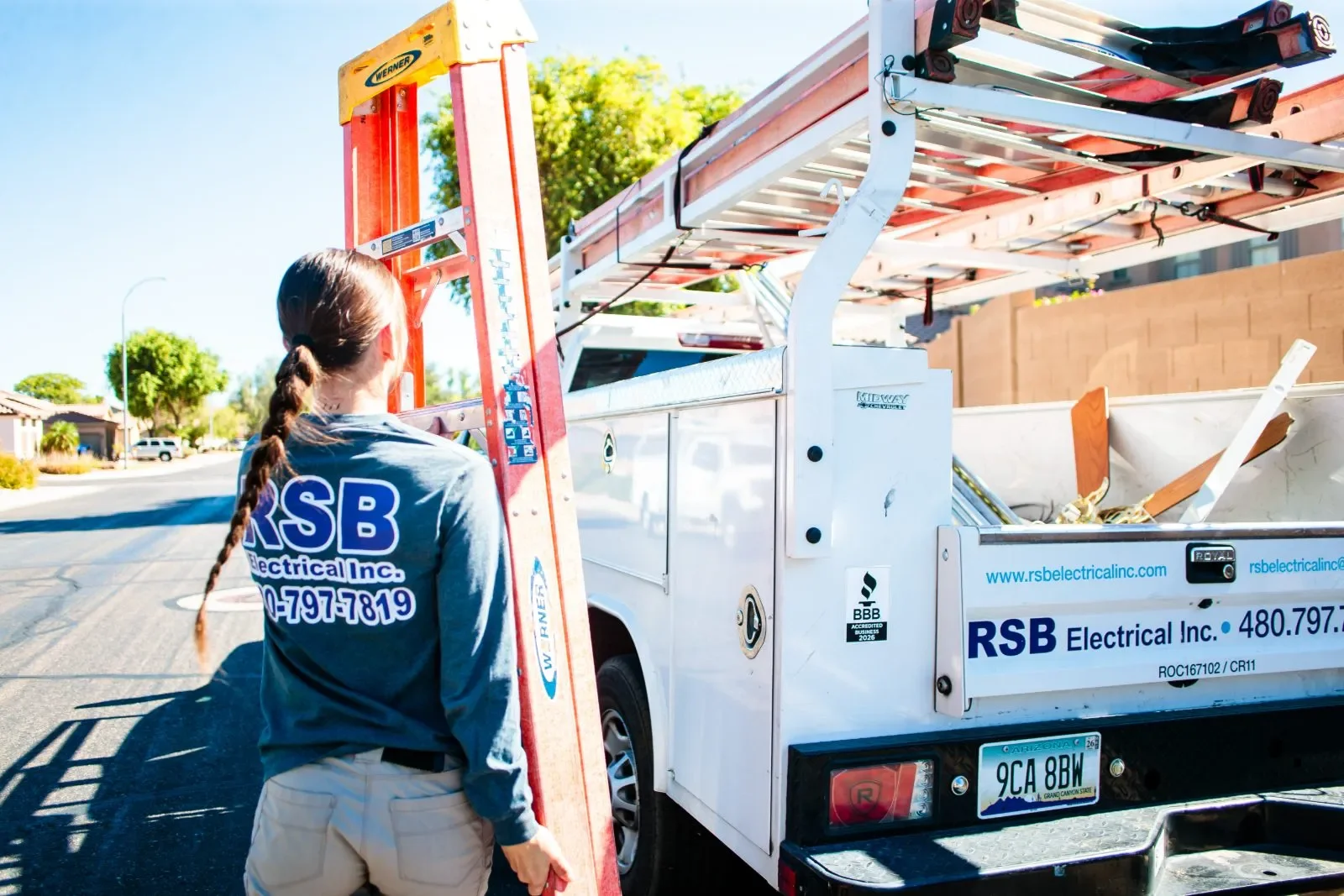
Apache Junction whole-house rewiring — RSB Electrical service truck
Home Service Areas Apache Junction Whole-House Rewiring
AZ ROC License #167102 (CR-11) Family-Owned & Operated Since 2001 Available 24/7 Free Estimates Licensed & Insured Highly Rated on Google

Whole-House Rewiring in Apache Junction, AZ

What It Is Like to Live Through | AZ ROC License #167102 (CR-11) | Family-Owned Since 2001 | Free Estimates

Which rooms go dark? For how long? How much wall comes off? Can we stay in the house? Those are the four questions households ask once they have been told they need a rewire, and plenty still ask them after the estimate arrives.

Whether you can stay, how much wall comes off, and how long it runs all have general answers. Which rooms go dark and when does not, and never will until somebody has walked your house; that one lands in the written schedule. Whether the house needs the work at all belongs with the assessment, where there is evidence to look at. RSB has been doing this since 2001, and Sharee, who runs the office, files the permits and tells you who is coming to inspect.

2001 family-owned since Free estimates CR-11 licensed & insured
You can usually stay Written schedule before cutting Permits filed by us
Living Through It

You Can Usually Stay, and Here Is What You Give Up

Households usually stay in the house through a rewire. The work moves through the house in groups of zones, so the parts finished or not yet started keep running normally while one group is the active work. Cooling and the refrigerator are planned from day one because, in an Arizona summer, those two decide whether staying is realistic.

What you give up is tidiness and quiet, one area at a time, for a stretch of days each. Openings appear where devices and junctions live and where a run has to cross; there is dust despite sheeting, and each zone loses power entirely while the old cable comes out and the new goes in.

The things we most often find out too late: somebody working from home with meetings in the room we are opening that week, a full freezer nobody mentioned, a dog that cannot be in the house with strangers. Easy to work around when we know on day one, awkward when we learn on day four. That is what the walkthrough is for, and we will over-ask.

The Sequence

What Happens, in Order

Two things happen once at the start: the walkthrough, and where it is part of the job, the new service and panel, which carries its own inspection before the utility will reconnect. After that, the same four steps repeat for each group of zones, because the rough inspection sits inside them. Rough-in, rough inspection, close up and patch, trim out, and that group is normally back on before the next one opens. When the last group is done, one final inspection covers the whole job, and the paperwork comes to you. Access drives the timing more than square footage does, and you get your version of this schedule before anyone else starts.

The walkthrough, and the list of what cannot be interrupted

Before any work, we walk the house and write down what has to keep running: medical equipment, the refrigerator and freezer, a home office and which days matter, the cooling. That list drives the sequence, so tell us more than you think we need.

The new service and panel, where they are part of the job

Getting the panel in early means every zone that follows lands into finished equipment. This is the day with the longest single power interruption; it carries its own inspection before the utility will reconnect, and it moves on the utility's schedule for the disconnect, so the date is booked around them and confirmed with you as soon as it is fixed.

Rough-in, zone by zone

New cable is pulled, boxes are set, and circuits are made up, working through the group a zone at a time. Whatever you use least goes into the first group, so the disruption starts where it matters least. The walkthrough is where we find out which rooms those are. The zones in the group are dark. The rest of the house runs.

The rough inspection, with the walls still open

The inspector sees the wiring in that group before anything closes up. Nothing gets covered until it is signed, which is why patching does not start the day after rough-in, however untidy the house looks.

Closing up and patching

Drywall goes back and gets patched. On some jobs we arrange the finisher, and on others you use your own, and the estimate names which. Texture and paint matching is its own trade, and we will tell you honestly where a join is going to show.

Trim-out

Outlets, switches, and fixtures go on, and the group is energized and tested where the inspector is content for it to be. Then the next group opens. When the last one closes, the panel schedule is filled in legibly, and the final inspection covers the whole job.

Apache Junction Conditions

Rewiring on an Occupied Street

Two variables decide how much a rewire disrupts you: how the cable can get around, and how close the neighbors are. In this city, both have come out the same way on nearly every job we have taken. Slab on grade, so there is no underfloor route, and the cable goes through the attic and down inside walls, which sets how many openings appear and how much patching follows. And close neighbors. The houses we have worked in here have had occupied lots hard against them on both sides, which is not true everywhere and is not something to discover on the first morning, so it is what we plan for.

So our schedule covers where the van parks, where the materials stage is, where the removed cable goes, and what hours the noisy work runs. Agreed in advance, it is a two-minute conversation. Unagreed it becomes a complaint on the third morning.

How the Work Goes

Everything Around the Work Itself

An assessment that opens things up

Devices come off, junctions get looked at, the panel is opened, and the attic gets walked, with your agreement on how far that goes. You get photographs of what was found. A rewire estimate written from a walk through the rooms is guesswork.

Scope decided from what was found

Whole house, or only the circuits the evidence puts on the list. You see the reasoning either way, including where it points at a narrower scope than you expected.

Permits and inspections, filed by us

A rewire is permitted work: a rough inspection per group of zones, one of its own for a new service, and a final that closes the job. All of it filed by us.

The schedule, in writing

One document, agreed before the first cut: zone order, interruption windows, what stays on, parking and staging, a realistic finish date, and your list of what cannot be interrupted. Changing a plan mid-job is workable. Changing an assumption mid-job is not.

Close-out and warranty

The inspection sign-offs, the photographs from the assessment, and one year on labor and materials. On a phased job, that coverage starts on each group as it is signed off and energized, which cuts both ways: the first group is covered from the day it goes back on, and its year runs out a year later.

Every Electrical Service in Apache Junction

Everything Else We Cover in Apache Junction

A rewire usually starts with a smaller question. The rest of the Apache Junction pages:

⚡ Apache Junction Whole-House Rewiring FAQs

Apache Junction Rewiring Questions

1.Can we live in the house during a rewire?

Usually yes. The one thing to decide early is whether somebody home all day would rather be out for the heaviest week, because that changes the zone order and it is better said at the walkthrough than in week two.

2.How long does it take?

Weeks for a whole house, with each zone taking a few days, plus inspections and patching. An accessible attic does more for the timeline than anything else.

3.Does a slab house take longer?

Compared with a house you can get underneath, yes, and slab is what we find here. An accessible attic is the single thing that shortens it.

4.How much of my walls comes off?

Less than people fear and more than nothing. What matters more than the amount is that you see the expected opening locations marked before anybody cuts anything.

5.Who repairs the drywall?

Whoever the estimate says, and it says so explicitly rather than leaving it to be argued about later.

6.Do I have to do the whole house at once?

Often you do not. The assessment tells you which circuits are actually driving the decision, and where it clears most of the house, you hear that.

Apache Junction whole-house rewiring — RSB Electrical

Considering a rewire?

Book the assessment first — photographs of what is in your walls and a written picture of living through it.

Call (480) 485-4284

Book the Assessment First, Decide Later

The assessment gives you two things before you decide anything: photographs of what is actually in your walls, and a written picture of what living here would be like while it is replaced. Read both, and you will know whether this is a job for this year, next year, or three circuits and a panel.

Because electrical work is not just about making something work. It is about making sure it is safe, code-compliant, and reliable years from now.

Proof

What Apache Junction Customers Say

Our Google listing is not curated, and there is no testimonials page. The live feed below is the whole record, good and bad, which is the only version worth reading.