

What Working With Us on a Sign Looks Like
The Signs We Work On, and What We Do to Them
Monument and pylon signs
The freestanding sign at your entrance, usually on its own circuit running underground from the building. We repair the feed, the disconnect, the internal lighting and the controls, and we trace the underground faults that take the whole sign out without touching anything you can see.
Channel letters and reverse-lit letters
Individual illuminated letters on a building face, each fed from LED modules or a shared power supply. This is where the dark-letter problem lives.
Cabinet and box signs
The internally lit box that many strip centers and older storefronts use, whether the light source inside is LED, fluorescent or neon. Lamps, modules, transformers and supplies, the sockets and wiring inside the cabinet, and the circuit and controls feeding it.
Menu boards and drive-throughs
Menu board and order-point circuits, and drive-through lane lighting, scheduled so the lane is not closed during a meal period.
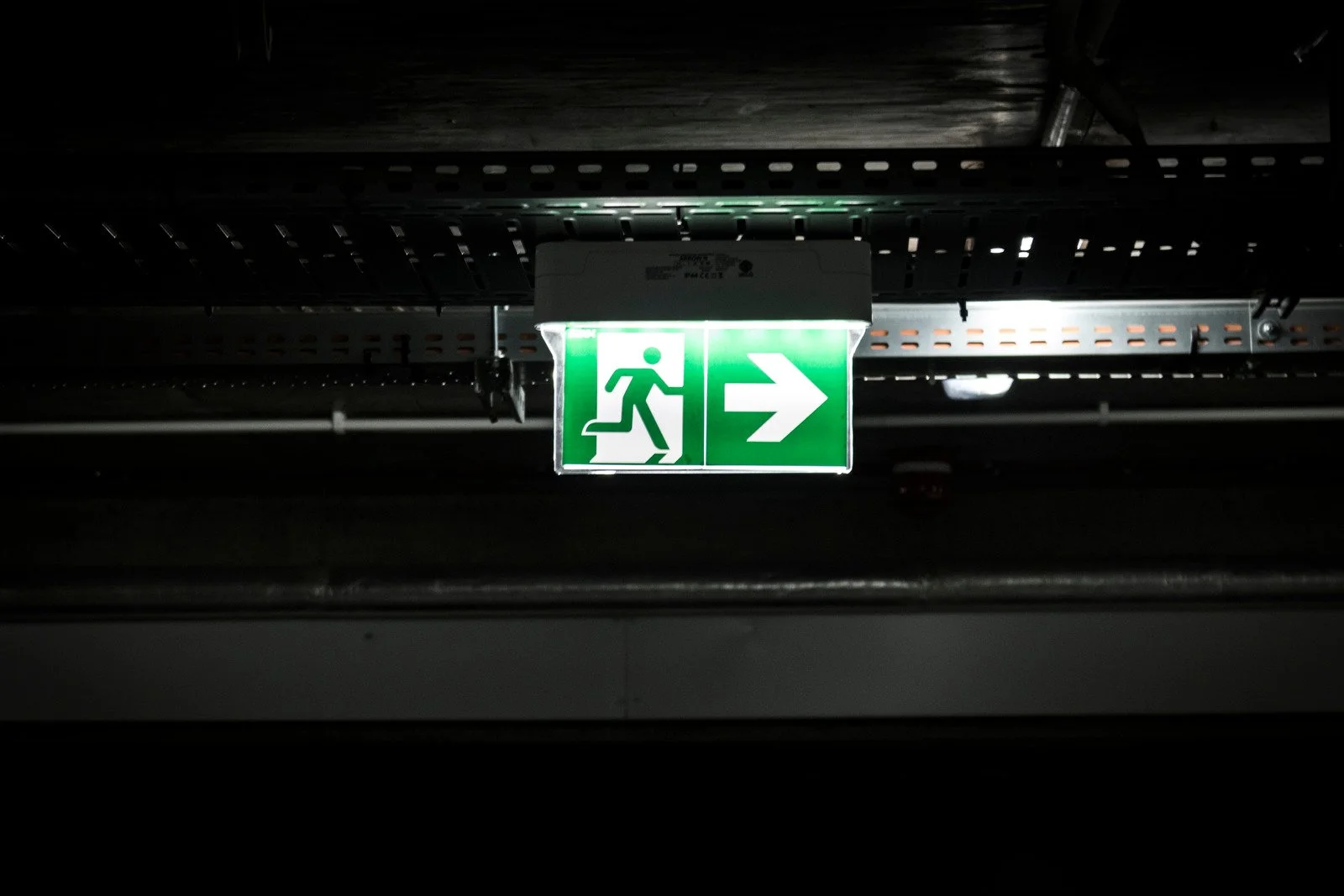
Exit signs and emergency egress
Exit and egress units repaired or replaced, battery function tested, on the same visit as the rest of your signage work.
What the Failure Pattern Tells Us Before We Arrive
How a sign fails narrows the cause more than anything else you can describe on the phone. These are the four patterns we ask about.
The whole sign, all at once
Everything dark together points upstream of the sign itself: the breaker, the disconnect, or on a freestanding monument sign the underground run between the building and the base. The sign is fine. What feeds it is not.
A group of letters, together
Channel letters are rarely wired one by one. They are grouped onto shared power supplies, so one failed supply takes out a run of letters while the rest stay lit. It is why three dark letters is usually one repair.
Flickering, or dimmer than it used to be
A supply partway through failing, or a connection corroded enough to add resistance without opening completely. Worth attention early, because the failing stage is where the cheap fix still exists.
Lit, but at the wrong hours
Nothing wrong with the lighting at all. This is the control: a timer, a photocell, or a contactor that is no longer switching. Businesses live with it for months because the sign does eventually come on.
Every Repair Starts With the Same Two Questions
Which utility serves the address, and whether the service runs overhead or underground. Get those right and the rest of the job follows.
What Mesa and the East Valley Do to a Sign
A sign is the only part of your building that works a night shift outdoors, and in this climate that costs it something.
A sign cabinet is sealed, and that is the problem
A parking lot fixture at least hangs in open air. A sign does not. Its electronics live inside a sealed cabinet or behind a plastic face, and that face absorbs sun all summer afternoon and the sealed enclosure behind it has nowhere to shed the heat. The electronics inside run hotter than the air all summer, which is why supplies fail here on something closer to a schedule than at random, and why late summer is when this work clusters. The face ages too, yellowing and going brittle under the ultraviolet load, so a sign that is lighting correctly can still be losing output through a panel that no longer passes light the way it did. We look at the face while we are inside the cabinet, because a relamp behind a yellowed panel is money half spent.
Arizona does not change its clocks, so a timer set once is wrong half the year
Most of Arizona does not observe daylight saving time, which makes sign controls behave differently here than almost anywhere a timer was designed for. Sunset still swings by more than two hours between December and June, but the clock never moves to meet it, so a control set in one season is drifting against the sky by the next. It costs money in both directions. A sign coming on at four in the afternoon in June is burning hours nobody sees. One still set for summer is dark through the early evening in December, which is exactly when a storefront most needs to be read. We set controls against the actual sky, on a scheduled visit, before the season turns.
Sign Lighting Questions Businesses Ask Us
1.Three of our letters are dark. Is that three repairs or one?
Almost always one, for the reason set out above: the letters share power supplies. Which letters went dark, and whether they sit next to each other, is the most useful thing you can tell us on the phone.
2.Our sign comes on in the afternoon, or not until late. Can you fix that?
Yes, and it is one of the simpler repairs we do. A timer drifts, or a photocell ages and starts misreading the light level, and either way the fix is at the control, not inside the sign. We reset or replace it and set it against the real sky.
3.Do you repair the sign itself, or only the electrical?
The electrical: the circuit, the disconnect, the controls, the drivers and supplies, the lamps and modules, and the wiring inside the cabinet. The physical sign, the faces, the vinyl and the cabinet fabrication belong to a sign company. If what you need is the face itself, we will tell you so before scheduling.
4.Can you work after we close?
Yes, and for a lot of sign jobs it is the better plan, especially where the access blocks a walkway or a drive-through lane. Overtime rates apply after 5 p.m. and on weekends and we tell you before we dispatch, so you can decide whether the convenience is worth it.
Two Photos and a Phone Call Is All We Need to Begin
It is the fastest way to tell us what we are dealing with. From there we come and look, because a sign cannot be diagnosed from the ground, and the written quote follows the next day and holds for 30 days. Estimates are free. And if the job turns out to belong to a sign fabricator, you will hear that from us first.