
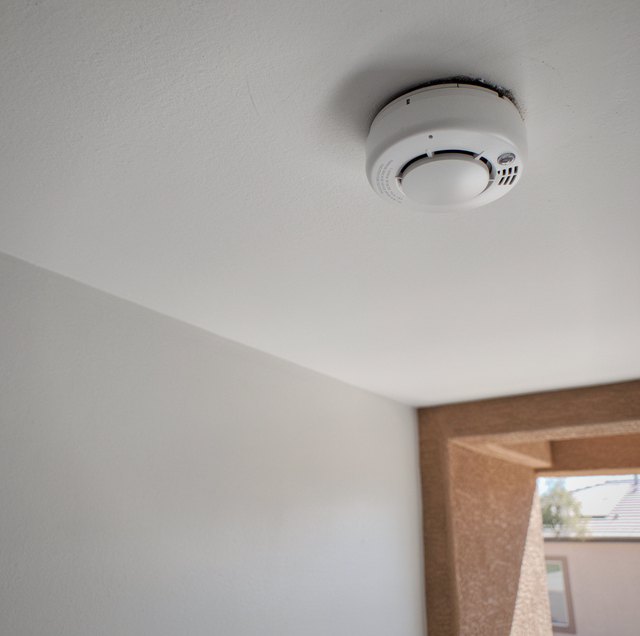
A hardwired smoke detector runs on house power. The battery inside it is a backup, there to keep the sensor and the horn working when the power drops, and the unit watches its voltage so it can warn you before the backup is gone. The warning is a short chirp. Because that one chirp covers several different conditions, a fresh battery clears one of them while leaving the others in place. When the chirp survives the swap, the detector is reporting something other than a tired battery: a battery it cannot read, a warning it has not cleared, a battery left carrying the unit without house power, a problem in another unit, or the end of its own working life.
The chirp's pattern and what the unit shows alongside it narrow that list before anyone climbs a ladder. Each row below pairs something you can hear or see from the floor with the condition it signals.
| What you notice | What it signals |
|---|---|
| A single chirp repeating at a steady interval, right after the swap | The battery is not seated, the drawer or cover is not fully closed, or the unit is still holding its earlier low-battery warning |
| A chirp paired with a flashing or colored light on the same unit | A fault or end-of-life code; on some models, a sensing chamber fouled by dust |
| A chirp from a unit whose power light is dark | The unit has lost house power, and the battery carrying it alone is draining |
| A chirp you cannot place to any one unit | A different detector on the system, or another battery-powered device in the home |
| A chirp that started after an outage or a breaker trip | Lost house power on the detector circuit, or a warning stored while the power was out |
| A CO or combination unit chirping on a pattern of its own | End of service life for the unit or its CO sensor |
A Chirp and an Alarm Are Different Signals
A chirp is one short, high note followed by a long silence. A full alarm is loud and continuous: smoke alarms sound in repeating groups of three beeps, CO alarms in groups of four, and some combination units add a spoken message naming the hazard. A detector sounding a full alarm is treated as an alarm first, whatever its battery history. For the three-beep pattern, get everyone out and call for help from outside; for the four-beep CO pattern, move everyone into fresh air and call from there. Troubleshooting a chirp starts only once the home is known to be safe.
Battery Fit and the Stored Low-Battery Signal
A hardwired unit can only read a battery that makes full contact with both terminals, and on some models, the drawer or cover must close completely before the terminals meet. A battery pushed in at a slight angle, a drawer left slightly open, or a battery installed against the polarity marks all cause the detector to sense a missing or weak backup, and it keeps chirping for that reason. The replacement must also match the battery type printed on the unit's label.
The second cause is memory. A detector that has been warning about a low battery can remain in that state after the battery is replaced, because its circuit retains a small stored charge and the unit rechecks its battery on its own schedule. On some models, pressing and holding the test/silence button, as the unit's label describes, forces a fresh check and clears the stored warning. The test sounds the horn at full volume, loud enough to hurt at close range, so hold the button at arm's length.
That button press is as far as the work at the detector goes for you. Some models call for a deeper reset, which means removing the unit from its mounting plate and disconnecting it from house power; that step belongs to an electrician because the plate connection carries household voltage. Reaching a ceiling detector takes a stable step stool or ladder; anyone unsteady on one should leave even the button press to someone else in the home.
Removing a hardwired detector from its plate to stop the chirp leaves the room without smoke detection, and removing the battery provides no backup during an outage. The harness carries household voltage; an electrician handles it and leaves a working unit up.
When a Hardwired Unit Has Lost House Power
A hardwired detector with house power shows it. On units that have one, a steady power light, green on some models, stays lit whenever the unit is on the house circuit. When that light is dark, the unit is running on its battery alone. The battery is then carrying the unit by itself and draining, so a new battery in an unpowered unit only buys time.
Two causes sit behind a dark power light. The first is a tripped breaker on the detector circuit, which you can check. The detector circuit can share a breaker with bedroom lights or outlets, so a room that went dark when the chirping began is a clue as to which breaker to check. A tripped breaker rests in the middle or off position, and it resets by pushing it fully off and then back on. If it trips again, leave it off: a breaker that will not hold is responding to a fault somewhere on that circuit, and finding the fault is an electrician's work.
The second cause is a loose connection where the detector plugs into its harness, or where that harness meets the wiring in the ceiling box. A loose connection can cut power to one unit while the other units on the circuit stay lit. Checking it means handling conductors that carry household voltage, so it stays on the electrician's side of the line.
A chirp that began after an outage or a breaker trip belongs here first. A unit whose breaker stayed tripped keeps running on its battery; a unit whose power came back can still hold a warning logged during the outage, which the button press clears on some models.
Finding the Unit That Is Chirping
In an interconnected system, the wire linking the detectors carries the alarm signal, so one unit sensing smoke sets off all the others. A low-battery or fault chirp does not travel that way. It comes from the unit reporting the problem, so the detector that received the new battery may not be the one making the noise. A short, high chirp is also hard to place by ear: it reflects off hallway walls and ceilings, and a unit inside a bedroom can sound as if it sits in the hall outside.
Standing under each unit, a few chirps, watching for a light that blinks in step with the sound, narrows the search to one detector; on some models, the unit that chirped keeps flashing a distinct light after the sound stops. If no ceiling unit turns out to be the source, other battery devices in the home make a similar sound: a plug-in CO alarm in an outlet, a security-system sensor, a thermostat with a low battery, or a spare detector stored in a closet with its battery still inside.
A chirp that seems to fill a hallway can be tracked from the floor: with every bedroom door closed, opening them one at a time while listening from the hall shows which room gets louder.
End-of-Life Signals and the Date on the Unit
Smoke and CO sensors both wear out, and newer detectors are built to announce it. On a unit with that feature, an expired service life produces a warning that no battery can clear. On some models, that is a chirp in a different pattern from the low-battery chirp; on others, a chirp paired with a flashing light; and on some combination units, a spoken message. A CO or combination unit can run its end-of-life warning on a pattern separate from its battery warning, so one chirping on its own schedule needs its label read before another battery goes in.
A detector carries a manufacture date and, on some labels, a replace-by date as well. On some models, the date is on the side; on others, it is on the back, and on a hardwired unit, reading the back means taking the unit off its plate, which is part of an electrician's visit and not a ladder job for you.
A fault code can also come from inside the sensing chamber. Dust, insects, or construction residue can foul the chamber, and on some models, the unit reports the condition with its own chirp or light pattern. A fouled chamber is one of several causes of a fault signal, alongside an aging sensor and an internal failure, and the pattern chart on the label is what separates them.
When the Fix Is a New Unit or a New Set
A unit reporting end-of-life, a fault signal that returns after a battery check, a chirp that persists with a seated battery, a cleared warning, and confirmed house power are signs that a unit is due for replacement. The open question is whether one unit goes or the whole set. Detectors in a hardwired system are installed together on a new build or a rewire, so the date on one can be the date on the others. When one of those reports end of life, the rest are the same age, and replacing the set at once resets that date across the whole house.
A new set also gets its interconnect proven end-to-end.
A chirp that continues after a new unit goes up on the same harness leaves the wiring as the cause to examine: a loose conductor at the ceiling box, a damaged harness connector, or, on some systems, a fault on the interconnect wire itself that can make units chirp. Each of those sits behind the mounting plate, where only an electrician should be working.
Frequently Asked Questions
On an interconnected system, it can. Pressing the test on one unit sends the alarm signal down the interconnect, and every linked unit sounds. That is loud but useful: a unit that stays silent while the others sound is not receiving the signal, which is worth mentioning to an electrician. Warn anyone asleep in the house before you press it.
Yes. Batteries lose charge while they sit in storage, and one kept in a drawer for years can start out low enough that the detector reads it as weak. The package carries an expiration date, and a battery near or past that date is a poor choice for a detector even if it has never been used.
Only if the unit's label lists one. A rechargeable battery can sit at a lower voltage than the alkaline or lithium type the detector expects, and that lower voltage is enough to set off the low-battery chirp even when the battery has just come off the charger.
Not without checking compatibility. Interconnected units must be listed as compatible with one another to share the alarm signal, and brands can use different harness plugs, so a different brand may require a new harness at the mounting plate.
On some models, the silence button mutes a low-battery or end-of-life chirp for a set period, and the chirp returns when that period ends. A unit silenced by accident, or silenced by someone who meant to test it, can seem fixed and then resume. The return indicates that the condition behind the chirp is still present.
It depends on the chirp. A unit chirping for a low backup battery still senses smoke and sounds its alarm while house power is on. A unit reporting end-of-life or a sensor fault cannot be relied on to detect smoke, and a unit with no house power and a flat battery offers no protection at all. That difference is the reason to read the pattern rather than silence it.
Reserve smoke and CO detector troubleshooting — a chirp that outlasts a fresh battery is traced through the unit, its house power, and the interconnect, with whole-home detector replacement when a set has reached its end. RSB Electrical Inc. serves Mesa and the Phoenix Valley. ROC 167102. Call (480) 485-4284.