
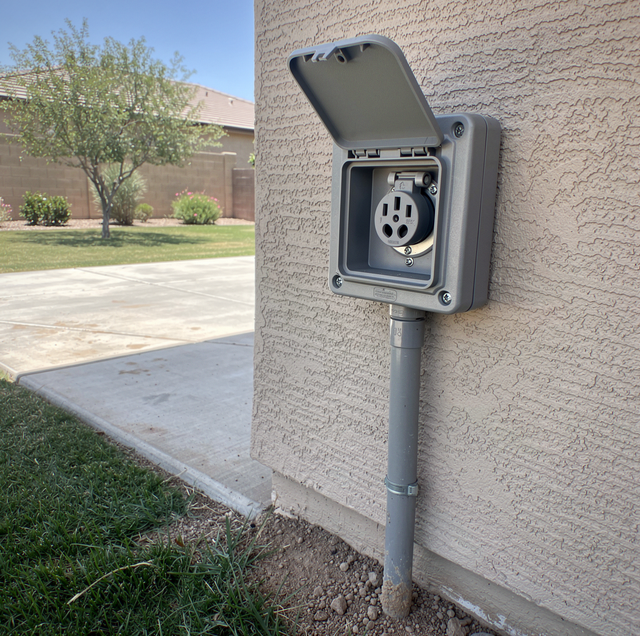
A home RV hookup, on the electrical side, is a dedicated outdoor circuit that runs from a breaker in the house panel to an RV-style receptacle beside the spot where the coach parks. Every part of that path is chosen to fit the shore-power cord the RV already carries. That cord and its plug were built for one of two service classes, and the receptacle at the end of the new circuit has to be the one the plug mates with, wired for the service the coach expects. Working backward from the cord, the planning questions and what each one settles run in this order:
| Planning question | What gets decided | Why it matters |
|---|---|---|
| Which service do the RV's cord and plug call for? | The smaller single-voltage service or the larger split-voltage service | The receptacle, breaker, and conductors all follow from this one answer |
| Where does the coach park, and how far is that from the panel? | The receptacle location and the length of the run | Length changes conductor size and the route the circuit takes |
| What does the panel have room for? | Whether the circuit lands in the existing panel or the panel needs work first | A circuit the service cannot carry trips or runs hot under a full coach load |
| How does the circuit cross the yard? | The conduit route, burial, and any crossing under paving | A buried run is hard to reach once the yard is finished over it |
| What does the receptacle sit in, and how is it protected from weather? | The enclosure, the receptacle type, and the cover | The connection has to stay dry with a cord left plugged in |
Two RV Service Classes and the Plugs That Match Them
RV shore power comes in two classes. The smaller single-voltage service uses a three-prong plug carrying one hot conductor, one neutral and one ground, and it delivers ordinary household voltage to the coach. The larger split-voltage service uses a four-prong plug carrying two hot conductors, a neutral, and a ground. Inside a coach built for the larger service, the appliances are divided between the two hots, so each half of the coach runs at household voltage while the pair gives the coach a larger power budget to draw on.
The coach decides which class the circuit serves: its cord, its main breaker, and the split of its loads were set when it was built. A circuit matched to that service lets the cord plug in directly, with nothing between plug and receptacle.
Miswiring Behind a Receptacle That Fits
Receptacle faces are shaped so that a plug from the wrong service will not go in. That shape says nothing about which wires are connected to the terminals behind the face, and the core hazard of a home RV hookup is back there.
The mix-up behind the worst damage starts with the smaller RV receptacle fed by a two-pole breaker, as on a dryer or shop circuit. One hot conductor lands on the receptacle's hot terminal and the second hot lands on the terminal meant for the neutral. The coach's plug seats perfectly. The coach, expecting household voltage between hot and neutral, receives the full split voltage, beyond what its outlets, battery charger, microwave, and air-conditioner controls are built to take. Electronics can fail the moment power is applied, and overheating components inside the coach pose a fire risk.
The larger service has failure points of its own. Its four conductors each connect to a matching terminal, with ground and neutral kept to their separate roles, just as a four-wire dryer circuit does. A loose or missing neutral on this service lets the voltage between the two halves of the coach drift apart, so one half can run high while the other runs low, and the appliances on the high side take the brunt of the damage.
Adapters that let an RV plug into a dryer or range receptacle carry the same danger in another form. Those receptacles sit on split-voltage appliance circuits, and an adapter can route that voltage into a coach built for the smaller service. An RV is never connected that way, however well the adapter seems to fit.
Panel Capacity and the Load Calculation
A parked coach can run its air conditioner, refrigerator, and battery charger continuously, so an RV circuit is a sustained addition to the home's demand. Before a breaker is chosen, the electrician runs a load calculation. It totals the demand the house already carries, from cooling equipment and cooking to water heating and any EV charger, and sets the RV circuit against the rating of the service. The method is the one the local inspection authority accepts.
The calculation answers two questions:
- Capacity: Whether the service can carry the house and the coach together without the main breaker and the service conductors running at their limit.
- Space: Whether the panel has an open position for the breaker the RV circuit needs, a single-pole breaker for the smaller service, or a two-pole breaker for the larger one.
The answers decide the scope. A panel with both capacity and space takes the new circuit directly. A panel with capacity and no open positions can gain spaces through a subpanel. A service without the capacity for the coach calls for a panel upgrade to a larger service before the RV circuit is installed, and any aging or failing panel found along the way can be replaced in the same job.
The breaker rating and the conductor size are chosen as a set for the RV service class, and the run length can increase the conductor size from there.
The Run to the Parking Spot
The parking spot sets the route. Where the coach sits against the side of the house or the garage, the circuit can run along or through the building and end in a wall-mounted receptacle. Where it sits across the yard, beside a side gate, or where a driveway ends, the run goes underground.
Buried runs are laid in conduit. The conduit type and its burial depth are tied together, and both change where the route passes under a driveway or anywhere vehicles cross; the electrician sets them to the rules in force for that route. Water reaches the interior of underground conduits through condensation and seepage, so the conductors pulled through them are type-rated for wet locations. Where the route crosses pavers, a slab or a driveway, the conduit is bored beneath the paving, or laid in a sleeve before new paving goes down. Before any trench is opened, buried utility lines are located and marked, and the route is set to avoid them. Trenching near buried lines is not a homeowner task.
Each foot of conductor adds resistance, and at the end of a long run the voltage sags when the coach's air-conditioner compressor starts. A long run may require a larger conductor than the breaker alone would need, so the coach sees steady voltage at the receptacle. Where the run rises out of the ground, the conduit continues up to the enclosure, so no conductor is left exposed at grade.
The Outdoor Receptacle, Its Enclosure and In-Use Cover
The receptacle goes where the coach's shore cord reaches it without strain: on a post, a pedestal or a wall, placed so the cord does not cross a walkway or the path of a car. It sits high enough to stay clear of standing water and sprinkler spray.
Outdoors, the receptacle itself is weather-resistant, built to withstand moisture and temperature fluctuations, and it sits in an enclosure rated for wet locations. The cover is an in-use design: a hood that shuts over the plug while the cord remains attached. A flat flip cover seals only while nothing is plugged in, and an RV cord stays connected the whole time the coach is parked. Whether the circuit carries ground-fault protection, and in what form, is decided by the local authority that permits and inspects the job.
Some RV enclosures hold more than one receptacle: an RV receptacle alongside a standard outdoor receptacle for a pressure washer, a shop vacuum, or hand tools. Every receptacle in that housing is planned into the circuit and the load calculation from the start.
Testing Before the RV Plugs In
Before the coach connects, the electrician confirms that each terminal carries what the coach's service class expects, that the ground runs unbroken back to the panel, and that any ground-fault device on the circuit trips and resets. Terminal screws are tightened to their rated torque, and any permit inspection the local authority calls for is part of the same job.
The first connection is made with the coach's larger loads switched off, then brought on in turn, so a voltage sag or a trip shows up while someone is watching for it. The finished hookup carries power one way, from the house to the coach: it is never used to feed power back into the house, whether from the coach's generator or any other.
A hookup that trips, buzzes, or smells hot can be arcing at a loose terminal, a shock and fire hazard at the cord and enclosure. The RV stays unplugged and the hookup unused until an electrician opens the enclosure.
Frequently Asked Questions
Yes, through an adapter made for that pairing, with a hard limit. The adapter ties both of the coach's hot legs to the single hot conductor of the smaller service, so the entire coach shares one circuit's capacity. Two roof air conditioners, or one air conditioner with an electric water heater and a microwave, can trip the breaker, and the coach's loads have to be managed.
A plug-in power monitor, sometimes called an energy management system, sits between the receptacle and the shore cord. It reads the incoming power before passing it through, and it cuts the connection on reversed polarity, an open ground, an open neutral, or voltage outside a safe band. Some models reconnect on their own once the power returns to normal.
Yes. Enclosures built for RV hookups can carry their own breaker inside the housing, which gives a local disconnect at the parking spot. Switching it off leaves the receptacle dead while no coach is connected, and switching it on only after the cord is plugged in keeps the connection from being made under load.
When the parking spot also needs other power, such as a detached shed, a workbench, or yard lighting. A single feeder runs from the house panel to a small subpanel near the pad, and the RV receptacle and the other outdoor circuits branch from there, so the yard carries a single trench and conduit route for all of it. The feeder is sized for the combined outdoor load.
Only when the job reaches the service itself. A circuit added to a panel with capacity to spare stays entirely on the house side of the meter. When the job includes a service upgrade or a panel replacement, the utility disconnects and reconnects power at the meter. That coordination is arranged along with the permit as part of the upgrade.
The blade pattern is its own. The smaller RV plug has two flat blades set at an angle to each other, plus a round ground pin, while a household receptacle has two parallel vertical blades. Dryer and range receptacles use different slot patterns again, so the RV plug seats only in a receptacle made for the smaller RV service.
Set up an RV outlet circuit — appliance circuit wiring from the panel to a weather-resistant RV receptacle matched to the coach's plug and service class. RSB Electrical Inc. serves Mesa and the Phoenix Valley. ROC 167102. Call (480) 485-4284.