
LED Retrofit vs. Fluorescent Replacement: What's Smarter
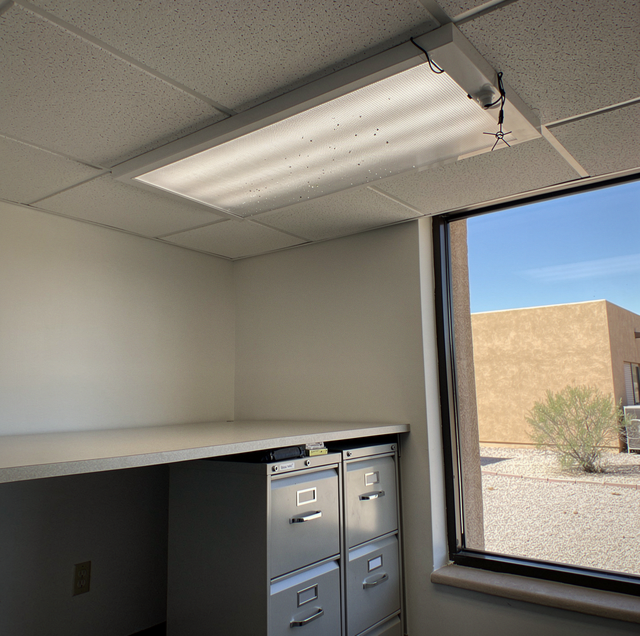
A back office hums faintly every time the lights are on, a sound nobody quite notices until the day it stops and the tube above the file cabinets flickers out for good. That hum and the flicker that shows up in the nearby tubes a few months later both trace back to the same aging part: the ballast. Deciding what to do about it (swap the tube, rewire the fixture, or replace the whole thing) depends less on which light bulb brand looks good on a spec sheet and more on understanding what that ballast has been doing all along.
Q: What's actually different between a fluorescent fixture and an LED retrofit?
A fluorescent tube produces light by passing a high voltage through a gas-filled tube to ionize mercury vapor inside it; the resulting ultraviolet light is converted by a phosphor coating on the inside of the tube into visible light. A ballast, either magnetic or electronic, supplies and regulates the high voltage in the first place. An LED tube skips all of that: diodes produce visible light directly from a low-voltage driver circuit, with no gas, no mercury, and no warm-up flicker while the tube reaches full brightness.
Q: What does "retrofitting" a fixture actually involve?
There are three real paths, and they're not interchangeable:
Ballast-compatible (Type A): An LED tube wired to work with the fixture's existing ballast, installed the same way a fluorescent tube swap would be, no rewiring involved.
Ballast-bypass (Type B): An LED tube wired to run directly off line voltage, bypassing the ballast entirely. This requires rewiring the tombstones (the sockets that hold each end of the tube) to feed power directly to the pins rather than through the ballast, work that should be done by a licensed electrician since it involves line-voltage connections inside the fixture.
Full fixture replacement (Type C): The entire fixture housing, including a dedicated LED driver, gets swapped out rather than adapting the old housing at all.
Q: When does a full fixture replacement make more sense than either retrofit option?
Once a fixture's housing has corroded, its lens has yellowed and gone brittle, or its reflector has degraded to the point of visibly dimming the output regardless of the lamp inside it, retrofitting a new tube into an aging housing won't fix a reflector or lens that's already degraded. Commercial spaces looking for a lower-profile fixture, rather than the same housing with a different tube inside, also tend to opt for full replacement.
Q: What's actually happening when a fluorescent ballast hums or fails?
A magnetic ballast's internal windings vibrate at line frequency as its laminated core ages, and that vibration is what produces the audible hum that gets louder as the ballast's internal insulation loosens with heat and years of operation. Electronic ballasts fail differently: their internal capacitors degrade over time, which shows up as flickering, slow starts, or a tube that won't start at all, well before the tube itself is actually at fault.
Q: Does the type of ballast already installed limit which retrofit options are available?
To some extent, yes. Fixtures built with older magnetic ballasts, particularly ones that predate electronic ballast designs, are common candidates for bypass conversion simply because a magnetic ballast nearing the end of its service life offers little upside to keeping in the circuit. Fixtures with a newer electronic ballast still well within its service life are often better suited to a ballast-compatible tube, since the ballast itself isn't the part causing trouble. Knowing which ballast type sits inside a fixture, not just how old the fixture looks from outside, is part of what an electrician checks before recommending a path.
Single-Ended vs Double-Ended Tubes: A Wiring Detail That Matters
Not all ballast-bypass LED tubes wire the same way, and mixing up the two types is one of the more common installation mistakes. A double-ended tube receives line voltage at both ends, meaning both tombstones carry live wiring, similar to how a standard fluorescent tube is powered from both sockets. A single-ended tube instead receives power from just one end, with the other end wired only for physical support, which changes how the tombstones get rewired during a bypass conversion. Installing a single-ended tube into a fixture wired for double-ended operation, or the reverse, can leave a tube unlit, cause a partial short, or in some cases keep voltage present at a socket that installers wouldn't expect to be live. This is one of several reasons ballast-bypass work is treated as an electrician's job rather than a same-day lamp swap.
How to Read a Fixture Before Choosing a Path
A few visible signs point toward which of the three retrofit paths actually makes sense before any tube comes down. A steady hum with tubes that light instantly and stay bright usually means a healthy magnetic ballast, a good candidate for a quick ballast-compatible swap. Slow starts, visible flickering, or tubes that only light at one end point toward a ballast already failing, which favors bypassing it rather than retrofitting around a part that's near the end of its life anyway. Yellowed or cracked lens covers, a housing with visible corrosion at the seams, or a reflector that's dulled enough to visibly dim the output all point past either retrofit option and toward full fixture replacement, since no tube change addresses a degraded housing.
What This Looks Like Across a Whole Building
A single-fixture decision is simple enough to make on the spot, but a building with dozens or hundreds of fixtures usually has all three conditions present at once: some fixtures with healthy ballasts, some with ballasts already showing wear, and a handful with housings past the point of retrofitting at all. Treating the whole building the same way, either retrofitting every fixture regardless of ballast condition or replacing every fixture outright, tends to either waste working ballasts that had years left or leave failing ones in place waiting to cause a callback. Sorting fixtures into the three categories above before ordering materials keeps a larger retrofit project from over-buying one type of tube or under-ordering full replacement fixtures for the housings that actually need them.
Comparing the Three Retrofit Paths
| Factor | Ballast-Compatible (Type A) | Ballast-Bypass (Type B) | Full Fixture Replacement (Type C) |
|---|---|---|---|
| Wiring changes needed | None | Tombstones rewired to line voltage | Entire fixture and driver swapped |
| Existing ballast | Stays in place, still powers the tube | Removed or disconnected from the circuit | Removed with the old housing |
| If the old ballast fails later | Tube goes dark until ballast is replaced | No effect; ballast is out of the circuit | No effect; no old ballast remains |
| Best fit | Ballast still working well, quick swap wanted | Ballast failing or near end of service life | Housing corroded, damaged, or being upgraded |
| Electrical work involved | Lamp change only | Line-voltage rewiring at the socket | Full fixture and wiring connection |
Dimming and Controls: Another Place Retrofits Can Trip Up
Fluorescent dimming, where it exists, relies on a dimmable ballast built specifically for that purpose, paired with a compatible wall dimmer switch. Swapping in a standard LED tube without checking whether the fixture's dimmable ballast is compatible with that specific tube can produce flickering, a limited dimming range, or a tube that simply won't dim smoothly even though the wall control still works. Ballast-bypass conversions remove this concern from the ballast side entirely, but only if the fixture is paired with an LED driver and dimmer combination rated to work together, which is a separate compatibility question from the ballast-compatible swap most people picture when they hear "LED retrofit."
Weighing a Retrofit Against a Full Fixture Change on Its Own Terms
None of the three paths is automatically the right call for every fixture in a space, which is part of why sorting fixtures by condition, rather than picking one approach for an entire project, tends to hold up better over time. A fixture with a healthy ballast, an intact housing, and no dimming requirements is usually the easiest candidate for a same-day tube swap. A fixture with a ballast already flickering or humming, but a housing still in good shape, is a reasonable bypass candidate. A fixture with a degraded housing, regardless of how the ballast is doing, is the one where a full replacement actually solves the problem instead of just changing what's inside an aging shell.
Frequently Asked Questions
No, a fixture should be converted as a matched pair. Mismatched tubes, or a ballast-bypass tube paired with a still-wired ballast, can cause flickering, uneven brightness between the two lamps, or added strain on a ballast that's now only driving one tube instead of two.
Common tube sizes have direct pin-compatible LED replacements that fit the same sockets, though ballast-bypass tubes require altering the socket wiring to route line voltage directly to the pins rather than through the ballast. Tube diameter matters here too: a T8 fixture and an older T12 fixture use different tube diameters. While LED replacements exist for both, they aren't interchangeable between fixture types, so matching the replacement tube to the fixture's actual diameter is as important as matching the pin style.
It's disconnected from the circuit, either physically removed or simply left unwired in place, since a bypass tube draws power directly from line voltage rather than routing it through the ballast at all. If it's left in place rather than pulled out, its wiring leads still need to be properly capped and insulated, since a disconnected ballast that looks original from the outside can be mistaken for a still-active one by whoever opens that fixture next.
Yes, in a small but real way. A ballast itself consumes some overhead wattage beyond what's needed to actually drive the tubes, so a bypass conversion typically lowers the fixture's total draw compared to keeping the original ballast in the circuit.
A ballast-compatible tube swap is a simple lamp change anyone comfortable with a ladder can do. Ballast-bypass conversions and full fixture replacements involve line-voltage wiring at the socket or junction box, which should be handled by a licensed electrician to ensure those connections are properly enclosed and grounded. Even a lamp-only swap is worth having a professional confirm first in a wet-location fixture or one running on a dimmer, since those two fixture types are the most likely to reveal a compatibility issue that an ordinary ballast-compatible change wouldn't cause elsewhere.
Generally, yes. LEDs convert more of their input energy into visible light rather than heat than fluorescent tubes and ballasts, which can measurably reduce the cooling load in a space with rows of fixtures running most of the day.
A double-ended tube draws line voltage at both ends, mirroring how a standard fluorescent tube is wired; a single-ended tube draws power at one end only, with the other end wired solely for mechanical support. The two require different tombstone rewiring during a bypass conversion, and installing the wrong type for how a fixture was wired can leave a tube dark or create an unexpected live connection. Single-ended tubes have become the more common style specified for new bypass conversions, largely because only one end of the socket carries voltage, which reduces the risk of a technician contacting a live tombstone during a future relamping.
Match the fix to what's actually failing behind the tube (the ballast, the housing, or neither) rather than to whichever option is easiest to order in bulk for the whole building at once. Do that fixture by fixture, and a retrofit project stops being three guesses wearing the same name and starts being three plain choices: swap the tube, bypass the ballast, or replace the fixture.
Get a lighting retrofit assessment — find out which conversion path actually fits your fixtures. RSB Electrical Inc. serves Mesa and the Phoenix Valley. ROC 167102. Call (480) 485-4284.
