
Panel Looks Fine? What an Infrared Scan Still Finds
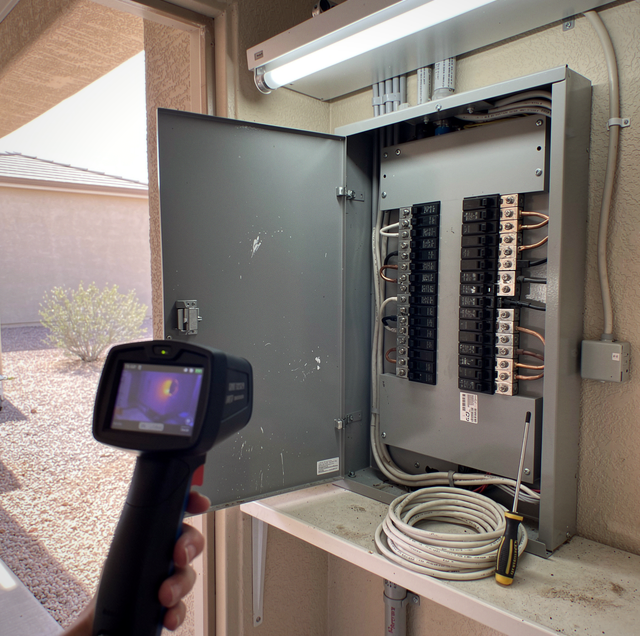
A loose lug carrying a normal branch-circuit load can sit near 180 degrees Fahrenheit, close to the temperature rating printed on the conductor's own insulation, while the steel cover in front of your panel feels no warmer than the wall. Nothing on that connection has changed color. Nothing smells. The plastic has not blistered, and the insulation has not gone stiff, because those are things heat does to a joint over months, and this joint has been running hot for weeks.
An infrared inspection finds the heat. A visual inspection reveals what the heat has already done to the surrounding parts. Both are looking at the same failing connection, and the distance between them is time.
The Heat Arrives Before the Mark Does
Current passing through a joint that has lost its clamping force encounters more resistance than the copper on either side. The power dissipated at that spot rises with the resistance and the square of the current, so a connection that is merely warm at a light load can run hot once the circuit is working. That power has nowhere to go except into the metal, the device body, and the air immediately around it.
Everything your eye finds is downstream of that. Brown or yellow staining on a receptacle face is the plastic cooking slowly from behind. A scorch shadow at the slots is further along again. Stiff, discolored conductor insulation develops from sustained heat over a long stretch. Each of those is a record of heating that has already occurred, and the joint has been getting worse the whole time because oxidation at a hot contact increases resistance, which raises the heat.
The temperature itself needs none of that accumulation. Put the circuit under load, and the difference exists in seconds. This is the ordering that matters to you: heat is a leading indicator of a bad connection, and the marks on the plastic are a trailing one. By the time you have something to find, the metal has been degrading for a while.
A Camera Only Sees Surfaces
A thermal imager detects infrared radiation leaving a surface and converts it into a surface temperature. It does not see through anything opaque, and a closed panel is opaque. Heat at a lug behind a deadfront has to conduct into surrounding metal, cross an air gap, and warm the steel cover before its outside face changes at all, flattening at every step. A survey shot through a closed enclosure can come back showing nothing unless the fault is severe enough to radiate through, which is why terminations are viewed directly, covers off, wherever that can be done safely. Pulling a deadfront on an energized panel carries an arc-flash hazard, so it must be done by a person qualified for that operation, in the protective equipment it calls for.
What an inspection finds at your house is bounded by what sits open in front of it. A splice inside a closed box in your wall and a junction box behind finished drywall radiate nothing to a lens. The surface being measured there is the drywall. Glass is its own case, since ordinary window glass and clear equipment covers block the wavelengths a building-trades imager works in, so a sight window changes what can be measured and does not make the parts behind it visible. The general walk-through of your home's wiring belongs to a different visit.
Which Faults Show Up as Heat, and Which Ones Stay Cold?
Anything moving current through added resistance announces itself. A terminal screw that relaxed through years of thermal cycling, or an aluminum-to-copper joint that has crept, turns a share of the load into heat at one small place, and the hotter that place runs, the faster its resistance climbs, which is why they get worse instead of holding steady.
Because current makes the heat, the finding scales with load. A survey works best at a minimum of 40 percent load, or the highest normal load available. In your house, it lands on the schedule. The circuits that give a bad connection away are the ones working hardest, and your visit has to overlap with them.
Plenty of real defects stay cold. A circuit sitting idle produces no signal, and the fault remains. So is anything carrying no current in normal operation, such as a missing equipment ground or a bonding jumper nobody landed. Those are found with a meter and with eyes, and a camera pointed at them gets room temperature.
Intermittent faults sit in between. An arc that appears only when a cord gets flexed produces heat while it misbehaves and nothing the rest of the time, and your scan is a snapshot of one afternoon. If your problem comes and goes, say so beforehand, since it changes what a technician tries to have running.
The Evidence a Camera Has No Way to Pick Up
Sight and smell reach things an imager will not, and the gap is widest when equipment is lightly loaded. Discolored insulation and the sharp hot smell near a receptacle both say heat happened, in the past tense, whether or not your circuits are drawing current that day. This is why the looking comes before the camera, and why load readings are taken last, so handling a conductor does not disturb the loose connection everyone is trying to find.
Workmanship is the same story. A lug with two conductors under a screw rated for one, or a breaker that does not belong in the panel it sits in, has no temperature yet and is plainly visible to somebody who knows to look. Corrosion creeping up an outdoor enclosure works the same way; a condition you can see long before it becomes warm. Your camera detects these when they begin to fail, which is when you would rather have known already.
A bright spot on a thermogram is not automatically a fault, and separating the real ones takes a person with the equipment. Polished metal behaves as a mirror at infrared wavelengths and can reflect a lamp or the technician. Heavy current can also induce heating in nearby ferrous parts, warming a steel bracket that carries no current of its own.
If your panel is mounted on an outside wall, note when the sun comes off that wall. Sunlight warms the whole enclosure and everything in it together, and a survey timed for shade removes that from the picture.
A Rise Measured Against the Conductor Beside It
Four degrees Celsius, about seven degrees Fahrenheit, is enough of a difference to put a finding in your report. The method is qualitative thermography: it compares one component's thermal signature with that of a similar component under similar loading, and the classification comes from the difference, not from any absolute number. Industry maintenance testing specifications publish suggested action levels that step up as the difference grows: one to three degrees Celsius over the reference warrants investigation; four to fifteen degrees Celsius warrants a probable deficiency to repair as time allows; and anything past fifteen degrees Celsius, roughly twenty-seven degrees Fahrenheit, is a major discrepancy. Those levels were written for distribution equipment maintenance rather than for a house, and what carries across to your load center is the method.
The reference is the part that method depends on, and it has to be genuine. The identical conductor beside the suspect one qualifies only if it carries comparable current, since an unloaded neighbor is a cold piece of metal and proves nothing about the warm one. With no matched component under the matched load, the comparison falls back to ambient air, where the same specification calls for a much larger gap: a rise has to reach about 11 degrees Celsius over ambient to mean what 4 over a loaded twin means. Finding that matched pair and confirming both ends are working is the first move on your panel.
Frequently Asked Questions
A spot thermometer returns a single number averaged across its entire field of view, and that field widens with distance, so at arm's length from your panel it may be blending a hot lug with the cool bus around it. An imager carries an array of detectors, each covering a small piece of the scene. Hence, a single warm termination in your panel remains distinct from its neighbors rather than being averaged away before you see it.
For terminations inside your panel, yes, and no camera setting gets around it. Being qualified to operate a thermal imager and being qualified to open energized equipment are two different qualifications, and the same person does not always hold both. If your panel cannot be opened safely on the day, an exterior pass still covers your receptacles, switches, fixtures, and any equipment already exposed.
Two things make a finding re-readable later. The load conditions at the time, given as actual amperes and as a share of the equipment's rating, because the same defect looks different at a quarter load and at full load. And the camera settings, particularly the emissivity value and background temperature used, since a number computed with the wrong emissivity cannot be compared against your next report.
Temperature at a breaker follows the current through it, and its internal heating rises as the load approaches its rating, so two identical devices on different loads end up at different temperatures with nothing wrong at either. Breakers also warm each other where they sit shoulder to shoulder, and the inside of an enclosure stratifies, so the top of your panel runs warmer than the bottom before any fault is involved. A useful comparison holds all of that roughly equal.
After a repair, mainly. A second image of the same termination under comparable load documents that the finding actually closed rather than moved. A finding on lightly loaded equipment also warrants a follow-up, because a small rise measured at a quarter of capacity can grow sharply if that circuit later carries what it was sized for, and your first image becomes the baseline it is measured against.
Bright bare metal. Polished copper emits only about 3% of the infrared that a good emitter gives off at the same temperature, so a hot, shiny lug can sit near room temperature on your screen while reflecting its surroundings. Heavily oxidized copper behaves far better, near 0.78. The answers are to measure the insulated conductor at the joint instead, or to apply a high-emissivity target such as electrical tape, near 0.95, where that is safe.
An infrared pass booked while ceilings and walls are still open reaches junction boxes and terminations that go out of reach the moment a finish trade closes them in — once those surfaces are covered, the same survey stops at the drywall until something is opened again. RSB Electrical Inc. serves Mesa and the Phoenix Valley. ROC 167102. Call (480) 485-4284.
