
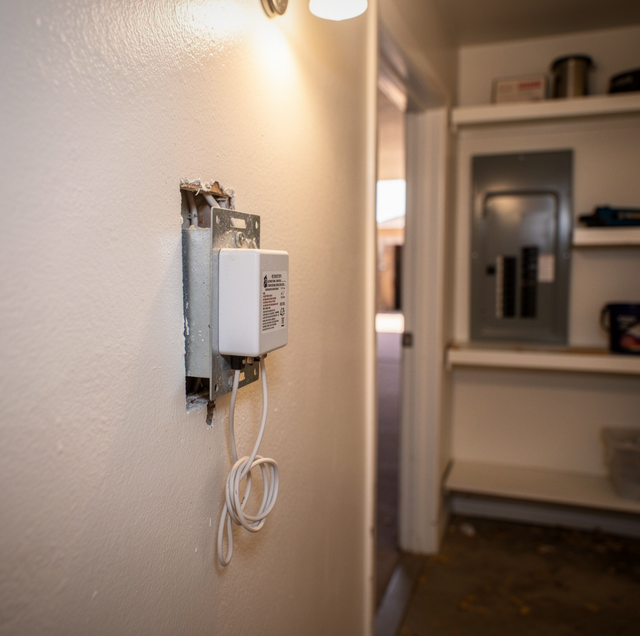
A new video doorbell goes up on a Friday, works cleanly through the weekend, and starts rebooting itself by Tuesday. The live view freezes mid-clip, the app marks the doorbell offline for a few minutes, and it reconnects on its own like nothing happened. Swapping it for a different unit doesn't change the pattern. The replacement does the same thing, at the same time of day, ringing at the same face on the porch. That repetition is the tell. Something in the circuit feeding the doorbell is running close to its limit, long before the doorbell itself gives out.
The Doorbell Circuit Has Three Parts, and One Carries a Rating
A hardwired doorbell circuit has three parts: a transformer, two small conductors, and a chime. The transformer usually lives wherever it was easiest to tap into household wiring during construction: mounted to a junction box near the panel, in a basement, attic, garage, or utility closet. Proximity to the front door was never part of that decision. Its job is to step down the full household voltage to a low, safe secondary voltage, carried on a light two-conductor cable, sometimes still called bell wire, that runs to the pushbutton and the chime.
That transformer carries a nameplate rating in volts and VA, which describes how much low-voltage power it can supply continuously. A transformer already in the wall was installed with the house, sized for whatever chime came with it, typically a simple mechanical bell that only drew current in the instant someone pressed the button and sat idle the rest of the day. A video doorbell is a small camera and radio that stays partially powered around the clock to hold its connection and watch for motion, then draws a sharp spike of current every time it activates, records, or talks back through its speaker. That's a different kind of load sitting on the same small transformer, over the same thin wire, that used to feed a bell that woke up for two seconds a day.
Reboots, Freezes, and Low-Voltage Warnings Point at Supply
A doorbell running short on supply produces a specific set of symptoms, and most of them look like software problems rather than power problems. The unit boots normally, connects to the home network, then reboots itself a few minutes or a few hours later, in a loop that repeats all day. Or it maintains a connection fine while it's idle, then drops the moment someone presses the button or trips the motion sensor, because that's when the current draw spikes and the supply voltage sags below what the board needs to keep running.
Night vision makes it worse. The infrared illuminators that light the porch after dark add to the draw on top of the camera, the radio, and the speaker, which is why a doorbell that behaves normally all day can drop its connection specifically after sunset. Some current models go a step further and report the fault directly, showing a low-voltage or insufficient-power warning in their own app rather than failing silently. That message is worth taking at face value. It's the doorbell measuring its own supply and reporting what it found.
A Long, Thin Wire Run Loses Voltage Before It Reaches the Door
A transformer rated correctly for a video doorbell can still starve it at the far end of a long, thin wire run. Doorbell wiring was never sized like a branch circuit. It's typically a light two-conductor cable, thinner than the wire feeding an outlet, chosen originally to carry a small current to a chime for a couple of seconds at a time. The resistance in that wire is small but nonzero, and the voltage drop across it increases with the length of the run and decreases as the wire gets thicker. A run long enough to reach a front door from wherever the transformer sits, often clear across the house from a utility room, garage, or panel, can lose a meaningful share of the transformer's output before it ever reaches the doorbell.
A mechanical chime never exposed that loss, because its draw was so brief that even a marginal supply reached it in time. A device that draws current continuously, over the same wire and the same distance, feels the full effect of that resistance for as long as it runs, whereas a bell only feels it for half a second at a time. The transformer at the source can be exactly the right size, and the doorbell can still be underpowered by the time the circuit reaches the porch.
A Buzzing or Silent Chime Is a Separate Fix from the Transformer
The chime itself introduces a second, unrelated failure mode. A mechanical chime uses an electromagnet to pull a metal plunger against one or two tone bars. A doorbell drawing a continuous trickle current to stay connected can leave the electromagnet very slightly energized between rings, producing a faint, persistent buzz or hum from the chime box even when nobody's at the door.
A digital chime doesn't have a plunger to buzz, but it carries the opposite problem. Many were built assuming a pushbutton simply completes and breaks a circuit, with nothing on the low-voltage side needing continuous power between rings. A video doorbell needs a continuous power supply to stay connected, and without a path for the trickle current to flow when the chime isn't sounding, the doorbell can lose power between rings or fail to trigger the chime at all. The usual fix on the digital side is a small add-on wired in line with the chime that gives the trickle current somewhere to go without needing the chime's own circuitry to carry it. None of this has anything to do with whether the transformer feeding the whole circuit is sized correctly. A chime that buzzes, or a doorbell that won't ring an otherwise connected chime, can sit on a transformer and a wire run that are both doing their job.
Some Houses Have No Transformer to Find at All
Not every house has a transformer to find. Some were built with a battery-powered or wireless pushbutton from the start and never had a hardwired chime circuit at all; behind the button there's nothing but a plastic backing and open air. Others had a wired doorbell once and lost it during a remodel, when drywall went up over a wall that used to carry the low-voltage run, or a renovation crew found two capped, unlabeled wires behind a wall plate and left them alone instead of tracing where they went.
In either case, what's missing isn't something to repair. It's a circuit that was never finished: a transformer mounted somewhere with access to household power, a low-voltage wire run from that transformer to the door, and a return run to wherever the chime will live. That's self-contained work, sized to one circuit. Whether it needs a permit is a question for the local building department. Whether the rest of the house's wiring is due for replacement is a separate question, decided by the condition of the wire already in the walls and bearing no relation to a single missing doorbell circuit.
Sorting Out Which One You Have Before You Call
None of this requires opening a panel or working on the transformer's line side to sort out which case applies. The two low-voltage conductors, the chime terminals, and the doorbell's mounting bracket carry a small fraction of a household branch circuit's voltage, which is why that side is the one a homeowner can look at without special training. Household voltage lives on the far side of the transformer and inside the panel that feeds it, and that side stays an electrician's job.
The transformer's line side and the panel feeding it carry full household voltage. Leave that side to a licensed electrician. Only the low-voltage wiring and the chime terminals are safe for a homeowner to inspect on this circuit.
| Symptom | Points To |
|---|---|
| Reboots, drops, or a low-voltage app warning, worse after dark | The transformer or the wire run |
| Chime buzzes, hums, or the doorbell won't ring it | The chime |
| No wire behind the button, or two capped ends with nothing connected | A missing circuit |
Knowing which row matches before the call keeps the visit focused on the actual fix instead of a second visit to figure out what the first one missed.
Frequently Asked Questions
Video doorbells print the required voltage and minimum VA rating on the unit itself or in the installation instructions, typically 16 to 24 volts AC. Older transformers installed for a mechanical chime were sized for a load that lasted an instant, not for a device that stays partially powered around the clock, and the nameplate on the transformer itself determines whether yours meets the doorbell's stated minimum. Matching the two nameplates, doorbell and transformer, is what catches a mismatch before it turns into reboots or an app warning.
Yes. Most video doorbells specify an acceptable voltage range in their installation instructions, and operating above that range from an oversized or mismatched transformer can make the doorbell run hot, shorten the life of its internal regulator, or trigger the same kind of intermittent reboot that a low-voltage supply causes. A transformer swap should match the doorbell's stated range at both ends, low and high.
Many wired video doorbells carry a small internal battery that recharges from the wired connection and can mask a weak supply for a while, drawing down slowly during the day and recharging overnight when demand on the circuit is lower. That buffering is why symptoms from an undersized transformer or a long wire run can take weeks to show up: the battery absorbs the shortfall until it can't keep up.
It gives the doorbell's trickle current a path to flow even when the chime's own internal components aren't passing it through, typically a small resistor or diode-based device wired in line between the transformer and the chime. Without it, a digital chime can block that steady low current entirely between rings, which leaves some video doorbells starved for power on a system where the transformer and wiring are otherwise sized correctly.
Yes. Many current models are built to run entirely on their internal battery, recharged by taking the unit off its mount every few weeks and charging it like any other rechargeable device, with no transformer or low-voltage run required. That's a workable option for a house with no existing doorbell circuit, at the cost of periodically pulling the unit down to recharge it.
Only in a limited way. Those two conductors typically carry less than 30 volts, well below the level that poses a meaningful shock risk. Touching both at once, or letting bare ends touch, usually trips the transformer's internal protection or opens a small fuse, cutting power to the doorbell circuit until it's reset. An older, unfused transformer doesn't always trip that cleanly. A sustained short left in place can burn it out instead, so the honest answer is that the low-voltage side isn't a shock hazard, but it can still destroy the transformer.
Schedule a doorbell circuit check — get the transformer, wiring, and chime confirmed and fixed in one visit. RSB Electrical Inc. serves Mesa and the Phoenix Valley. ROC 167102. Call (480) 485-4284.