
Does Your Home Need Rewiring? The Signs That Add Up
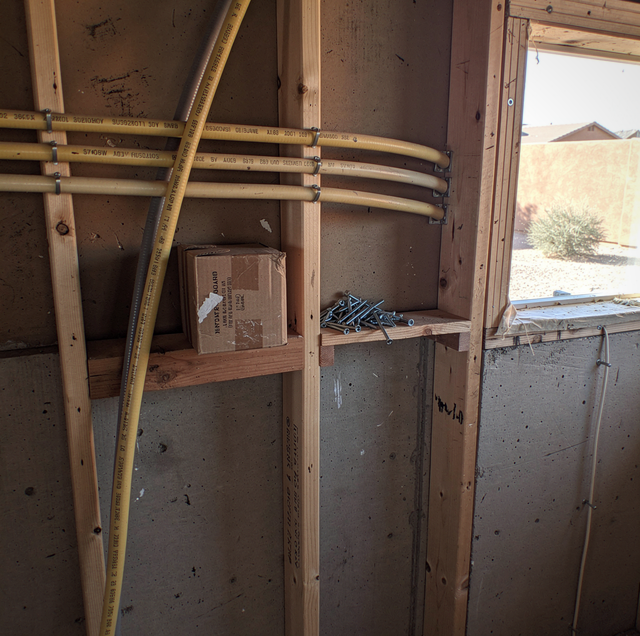
Quick Answer: A home becomes a rewiring candidate when several signs point in the same direction at once: pre-plastic cable jackets, two-slot outlets throughout, brittle or cloth insulation, repeated breaker trips on one circuit, and devices that run warm under normal use.
The evidence that a house needs rewiring is scattered, and thin wherever you find it. One sits in the attic, on a length of cable jacket nobody has looked at in years. One sits in a back bedroom, on a receptacle with two slots. One shows up in the laundry room every few weeks when the same breaker trips under the same load. Taken one at a time, none of these carries much weight. A two-slot outlet in a spare room proves nothing about the rest of the house, a breaker that trips has a dozen ordinary explanations, and a warm dimmer is doing what dimmers do.
What answers the question is the count: how many of these signs you find, how far apart they sit, and whether they point back to the same era and the same kind of wire. Most of it can be gathered without touching anything, because the useful evidence is already in plain view.
Before you start looking, split the question in two. How much power your service and panel can deliver is a capacity question, settled by equipment ratings and by what the house draws. Whether the wire running from that panel out to your outlets is fit to keep is a condition question, settled by what the conductors are made of and the shape of their insulation. A house can have room to spare in the panel and tired branch circuits behind the walls, and it can have healthy wiring fed by equipment that ran out of room years ago. Everything below is in condition.
Vintage, Cable Type, and Where They Show Themselves
Wiring materials change in recognizable stages, making age the first piece of evidence you have. Cloth-wrapped conductors, ceramic knobs supporting single wires, and early rubber insulation belong to periods that ended long ago. Plastic-sheathed cable came later, in versions that changed over the decades. None of this tells you a house is unsafe; it tells you which questions to ask about everything else you find.
You can see more of this than you expect from a standing position. The outside of a panel cabinet carries a manufacturer name, and often a directory card in someone's handwriting, and the cables entering its top are visible without opening it. An unfinished attic or basement usually exposes long runs of cable stapled across the framing, where the jacket, its color, and its printing are visible. Every receptacle shows the front of a device from some point in that history.
Look, and leave everything closed: Nothing here calls for removing a cover plate, pulling a device, or reaching into a cavity you cannot see into. If a cable is not already exposed, it is not part of your inventory.
| What you can see | What it points to |
|---|---|
| Fabric-braided cable jacket on runs in an attic or basement | Wiring installed before plastic-sheathed cable became standard |
| Ceramic knobs and porcelain tubes carrying single wires through framing | Knob-and-tube wiring, a system installed with no equipment ground anywhere on it |
| A dull gray conductor at an already exposed cable end | Possible aluminum branch wiring, which changes the weight of everything else on your list |
| Two-slot receptacles through most of the original rooms | Branch circuits run without an equipment ground |
| Three-prong receptacles in a house that is otherwise two-slot | Devices swapped at some point, with no guarantee the circuit behind them changed |
| Jacket that looks chalky, cracked, or hard and shiny | Insulation aging past the condition it was built to hold |
Keep a written list as you go: the room, what you saw, and whether the same thing turns up elsewhere. A pattern spread across four rooms carries far more weight than the same note made once.
Two Slots, Three Slots, and the Ground That Is Not There
You notice the two-slot outlets first, and they are the most honest evidence in the house. The third slot on a modern outlet connects to an equipment grounding conductor, a wire whose only job is to provide a deliberate path for fault current back to the panel so a breaker opens quickly. Older branch circuits were run without that conductor, so the outlets on them have two slots because there was never a third wire to land.
The problem starts when someone replaces those devices. A three-prong receptacle screwed onto an ungrounded circuit accepts a three-prong plug and looks current, and behind it nothing has changed. Every surge protector and piece of electronics plugged into it assumes a ground path exists, and on that circuit it does not. This is why a house full of clean modern outlets can still sit on original branch wiring.
Walk the original rooms and note the ratio, treating any three-prong outlet as a two-slot one with suspicion until an electrician confirms what is behind it.
Breaker Behavior That Repeats in the Same Spot
A breaker doing its job is not evidence of anything. Breakers exist to open, and the ones that open under a predictable, heavy load are reporting demand rather than damage. A circuit that gives out when a space heater joins a hair dryer, at roughly the same point every time, is describing what is plugged into it. Repeat tripping under heavy cooling load has its own causes and diagnostic path.
What belongs in the inventory is a different pattern: a breaker that opens with no consistent load behind it. Trips at odd hours with nothing significant running. Trips that follow someone bumping a wall or using a particular outlet. Trips that started occasionally and now happen weekly on a circuit whose usage never changed. Behavior that ignores load is tied to the conductors, the connections, or the insulation somewhere on that run, and worth writing down with the room the circuit serves.
Note whether the same breaker is involved every time, or the trouble moves around the panel. One circuit misbehaving points at one run. Several misbehaving in a house that also shows old cable and two-slot outlets is a far stronger reading.
Devices and Fixtures That Report on the Circuit Behind Them
Switches, outlets, and fixtures sit at the ends of the wiring, making them the only parts that talk back. A dimmer that runs slightly warm is normal, since the device dissipates some power as heat while it dims. A plain toggle switch that is warm to the touch should not be generating heat at all, and warmth there points to a connection working harder than it should. Heat or discoloration at an outlet face carries its own urgency; for the inventory, what counts is how many devices show it and whether they share a circuit. Sound and smell come from the same devices. A buzz or sizzle at a switch or outlet is current crossing a connection it should pass straight through, and a faint burning odor near a device is a same-day call to an electrician.
Lights that dim briefly when a large motor starts are ordinary. Lights that dim and stay dim while something runs, or that dim in one part of the house when a load starts in another, describe voltage falling across a length of wire. Note which rooms dim together, because that grouping usually maps to a single branch circuit.
Then there is grip. An outlet that no longer holds a plug, that lets a charger sag out under its weight, has worn contacts. Alone, that is one tired device; repeated across a house, it says the receptacles are original, and usually the wire feeding them too. Several outlets going dead together gets traced as its own fault, so record only what stays powered but loose.
Insulation Condition Where the Cable Is Visible
When old wiring finally causes trouble, the insulation is usually what let go first, and in accessible spaces you can see how it has held up. Judge it by eye, hands off: a chalky surface, splits where staples pin the cable to framing, fine crazing, or a jacket gone glossy-hard where it should look matte. Attic cable takes the worst of this, because attic air cycles through extreme heat daily for months and heat drives that aging.
Cloth-wrapped wiring ages differently. The braid frays, darkens, and falls away from the conductor in flakes, often worst where a cable enters a box or passes near a heat source. Where it has begun shedding, the conductors beneath are losing their separation from each other and from any nearby metal.
Two materials deserve to be named because both look unremarkable at a glance. Knob-and-tube, the ceramic-knob system named in the table above, is one. The other is aluminum branch wiring, small-gauge aluminum conductor used for ordinary 15- and 20-amp outlet and lighting circuits in one stretch of construction, which behaves differently at connection points than copper does, and what to do about it is answered on its own terms. Both belong on the inventory, and both belong to a licensed electrician from the moment you spot them.
Knob-and-tube and aluminum branch wiring are both real hazards that look ordinary from a standing position. Do not open, probe, or disturb either one. Have a licensed electrician confirm what is there and decide what happens next.
What an Assessment Settles That a Symptom Cannot
Every sign above shares one limitation: it is visible, and most of a house's wiring is not. The runs between panel and outlets pass through wall cavities, above finished ceilings, and behind insulation, and the connections that fail most often sit inside boxes you are not opening. A house can pass every check on your list and still hold a damaged run, a loose connection, or a splice buried where it never belonged. The reverse happens too: a house can show several worrying signs and still need only a handful of circuits addressed, with the rest sound.
That gap is what an assessment closes. It settles what the conductors actually are, whether your signs share one cause or three, and which circuits are involved. It settles whether a warm switch and a loose outlet in the same room sit on the same run, and whether your two-slot outlets are fed by the cable you found in the attic. It settles scope: how much of the house is in question and how much is fine.
Your inventory does real work here: it is the fastest way to decide whether the question deserves attention now, and it hands an electrician a map. Bring the list, and let someone qualified answer what the walls are keeping to themselves.
Frequently Asked Questions
No. Many houses have been worked on in pieces over the decades, so one address can hold two or three generations of wiring at once: original runs in untouched bedrooms, newer cable in a remodeled kitchen, something in between in an added bathroom. That mix is why scope gets decided circuit by circuit.
Circuits rarely follow room boundaries. A single branch circuit commonly picks up outlets in a bedroom, a hallway, and part of the room next door, in whatever order was convenient during construction. A fault on one run can cause complaints in places that appear unrelated on a floor plan, which is why an electrician maps circuits before diagnosing room-by-room symptoms.
It can carry a load, look undisturbed, and still be a concern. The system was built to run through open air, with conductors held clear of the framing so heat could shed into the surrounding space. When later owners blew insulation into those cavities, the clearance the design depended on disappeared. Any suspected knob-and-tube should be identified by a licensed electrician.
No. Large-gauge aluminum is ordinary for service-entrance and feeder conductors, and finding it at the panel says nothing about the branch circuits behind the walls. Those are what the question is about, and confirming which ones a house has is the work of a licensed electrician.
Some three-prong receptacles on ungrounded circuits carry a small marking to that effect on the face or the device yoke. It is a disclosure: the outlet accepts a three-prong plug, and nothing behind it is grounded. Finding one settles a question an outlet's shape alone leaves open.
Yes, and the reason is sequencing. Wiring runs behind the same surfaces that new drywall, flooring, insulation, and cabinetry cover. Those runs are easiest to reach in the moment before finishes close them in, so an early assessment settles wiring scope while cavities are open and keeps a later discovery from undoing completed work.
Request a wiring condition assessment — a licensed electrician confirms what your visible signs point to and checks the runs you cannot see. RSB Electrical Inc. serves Mesa and the Phoenix Valley. ROC 167102. Call (480) 485-4284.
