
Whole-House Surge Protector vs Power Strips: What Actually Guards Your Electronics
A surge is a fast, brief jump in voltage. Your home runs on roughly 120 volts at the outlet, and a surge pushes that far higher for a fraction of a second. That spike does not always announce itself. Sometimes it fries a device outright. More often, it chips away at sensitive components over months, until a TV, a game console, or a computer power supply quits earlier than it should for no reason you can point to.
There are two common tools people reach for: a whole-house surge protector wired at the electrical panel, and a plug-in surge strip at the outlet. They look like they do the same job. They do not. They stop different surges in different places, and the reason you often want both is where the surge comes from and where it lands.
Quick Answer: A whole-house (Type 2) surge protector installs at the panel and clamps large surges coming from the utility side or nearby lightning before they spread through the house. A plug-in surge strip sits at the outlet and clamps smaller spikes, plus the ones generated inside your home when motors cycle. Neither replaces the other. The strongest setup layers a panel unit with quality surge strips over your most sensitive electronics.
How A Surge Actually Reaches Your Electronics
Think of your home's wiring like the plumbing in a house. Water pressure that stays in range is fine. A sudden pressure spike, a hammer in the pipe, travels through the whole system and hits whatever is connected. Voltage behaves the same way. A spike enters or forms somewhere on the wiring and races outward to every device sharing that path.
Surges come from two directions, and that distinction drives everything else in this article.
External surges originate outside your walls. The utility switches equipment on the grid, a substation breaker trips, or lightning strikes a line or the ground nearby during a storm. These events can dump a large amount of energy onto the service wires feeding your panel. A close lightning strike does not need a direct hit on your roof to matter. The energy couples onto power and communication lines and arrives through the meter.
Internal surges are the quiet ones, and most homeowners never think about them. Every time a motor-driven appliance shuts off, the collapsing magnetic field kicks a small voltage spike back onto the circuit. Your air conditioner compressor, refrigerator, well pump, garage door opener, and even a laser printer all do this dozens of times a day. Each spike is small. Repeated thousands of times a year, they add up on the electronics sharing those circuits.
That split is the whole story. One tool is built for the big external hits. The other is built for the small, constant internal ones. Match the tool to the surge, and the picture gets clear fast.
What A Whole-House Surge Protector Does
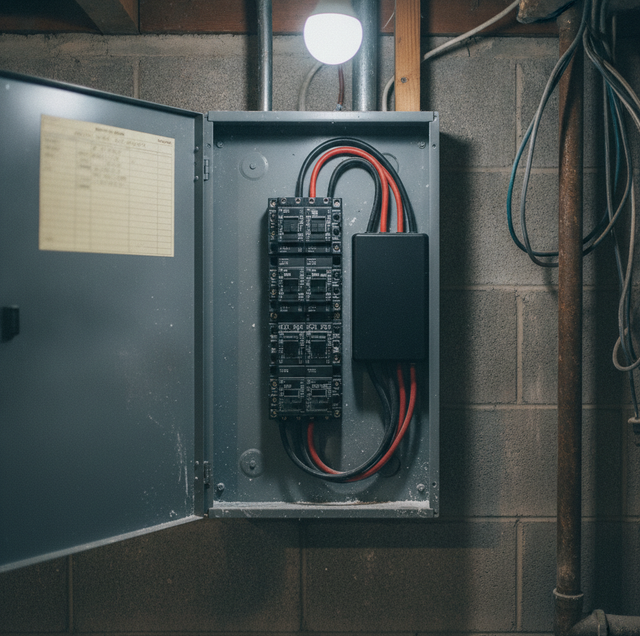
A whole-house surge protector, technically a Type 2 device, mounts at or inside your electrical panel and connects across the incoming lines. Its job is to sit at the front door of your electrical system and clamp large surges before they fan out to the branch circuits.
Inside, it uses metal oxide varistors, or MOVs. An MOV is a component that behaves like an open gate at normal voltage, and slams shut into a low-resistance path the instant voltage climbs past its threshold. When a surge hits, the MOV diverts that excess energy to ground instead of letting it flood into the house. The device knocks the peak voltage down to a level your equipment can shrug off.
Because it sits at the panel, one unit protects everything downstream at once. That includes the equipment you cannot plug into a strip: the central air conditioner and furnace, the electric water heater, kitchen and laundry appliances hardwired or on their own circuits, a well pump, ceiling fans, and increasingly the LED drivers behind recessed lighting, which are electronics in their own right and sensitive to voltage abuse. It also gives every outlet in the house a first line of defense.
What it does not do well is catch a surge right at a specific device. By the time an internally generated spike reaches the panel and comes back, or a small spike forms a few feet from your computer, the panel unit is too far upstream to blunt it at the point that matters. It handles the big picture. It is not the last inch of protection.
Installing one is work at the service panel, where the conductors are live, and the connections carry the home's full load. That is licensed-electrician territory. It is not a plug-in accessory, and it is not a project to open the panel for on your own.
What A Plug-In Surge Strip Does
A plug-in surge protector, the "surge strip," sits at the outlet right where your electronics live. It uses the same MOV technology, but in a smaller package, and it earns its place in two ways.
First, it clamps the smaller external spikes that slip past or were never big enough to trip the panel unit's threshold. Second, and this is the part people miss, it catches the internal surges generated close by. When the AC or the fridge on a nearby circuit cycles and kicks a spike back onto the wiring, the strip at your TV or computer is right there to absorb it at the device. The panel unit, sitting upstream, cannot do that job as well.
Here is the trap. Many products sold as "power strips" are not surge protectors at all. A basic power strip is nothing more than extra outlets on a cord, a splitter with no protective components inside. Plug your electronics into one of those, and you have convenience and zero surge protection. The two look nearly identical on the shelf.
Two things tell them apart. A real surge protector carries a joule rating, a number describing how much surge energy it can absorb over its life. A basic strip has no such rating because it absorbs nothing. A quality surge protector has a protection-status light, a small indicator that stays lit while the internal protection is still working. If your strip has neither, treat it as a plain splitter.
The MOV Wears Out, And That Is The Catch Nobody Mentions
The MOV that makes a surge protector work is a consumable. Every surge it absorbs degrades it a little. Large hits take a bigger bite, but even the steady drip of small internal spikes wears it down over time. Eventually, the MOV can no longer clamp effectively.
The dangerous part is how quietly this happens. A worn-out surge strip keeps passing power to your devices exactly as before. The TV turns on, the computer boots, and everything looks normal. The protection is simply gone, and nothing about the way it powers your gear tells you so. You could run for years thinking you are covered when you are not.
This is what the protection-status light is for. On a good strip, that light reports the health of the MOV, not just whether the outlet has power. When it goes dark or changes color, the protective element has reached the end of its useful life, and the strip needs replacing, even though it still works as an outlet. As a general habit, plan to replace surge strips every few years, and sooner in a home that takes frequent hits. Whole-house units also age, and many include their own status indicator worth checking during any electrical service visit.
Whole-House vs Surge Strip At A Glance
| Whole-House (Type 2) | Plug-In Surge Strip | |
|---|---|---|
| Where it installs | At the electrical panel | At the wall outlet |
| Surges it stops | Large utility-side and nearby lightning surges | Smaller spikes plus internally generated ones from cycling motors |
| Protects what | Everything downstream: HVAC, appliances, well pump, LED drivers, all outlets | The specific electronics plugged into it |
| Wears out? | Yes, MOV degrades over time; check its indicator | Yes, MOV degrades; replace every few years or when the status light goes out |
The table makes the division of labor obvious. One protects the whole house from the big external stuff. The other protects individual electronics from the small, close-in stuff. They cover for each other's blind spots, which is exactly why layering them beats picking one.
Why Layered Protection Wins
The strongest setup is not a choice between the two. It is working as layers. The panel unit takes the first and biggest hit, knocking a large incoming surge down to a fraction of its peak. Whatever energy still gets through, along with any spike born inside the house, meets the surge strip at the device, which clamps the remainder right where your electronics plug in.
You do not need a strip on every outlet in the house. Concentrate them where the sensitive and expensive equipment lives: the computer and its monitor, the TV and home theater gear, the router, modem, and network switch, and anything with a delicate power supply. Those are the devices worth the second layer.
For computers and network equipment specifically, a UPS, an uninterruptible power supply with a battery, adds one more benefit. Beyond surge protection, it provides ride-through: when the power dips or drops, the battery carries the load for a short window so a desktop or server can save work and shut down cleanly instead of crashing. It is an addition on top of panel-level protection, not a substitute for it.
One requirement ties all of this together: a proper ground. Surge devices work by diverting excess energy to ground. If an outlet is not properly grounded, or the panel's grounding is compromised, the surge protector has nowhere to send that energy and cannot do its job, no matter how high its joule rating. In older homes, especially, grounding is worth verifying, because a surge protector plugged into an ungrounded outlet is offering less protection than the light on its face suggests.
A couple of habits keep the whole system honest. Do not daisy-chain surge strips, one plugged into another. It overloads the protection, defeats the joule rating you paid for, and creates a fire risk. And give internal-surge sources their due: heavy motor loads like a central AC compressor cycling on and off all day, common anywhere summers run hot, generate internal spikes year-round, not just during storm season. Between grid switching and the occasional lightning-driven surge on one side and constant motor cycling on the other, both layers pull their weight in every month of the year.
Frequently Asked Questions
No, and the reason lies in how these units are classified. A Type 1 unit mounts on the line or service side, ahead of the panel, while a Type 2 unit mounts inside the panel on the load side, and most homes run a Type 2. Even a Type 2 does nothing for a surge generated downstream at the device itself, since that spike forms past the panel entirely. Keep quality strips on your sensitive gear so the two positions cover each other.
Check the label for a UL 1449 listing, a joule rating, and a "protected" status light. UL 1449 is the safety standard specific to surge devices, and the joule number tells you how much surge energy it can soak up before it wears out, so higher joules means more headroom over its life. The status light confirms the internal protection is live. A strip carrying none of those three is an outlet multiplier, nothing more.
Yes, the varistor inside is a consumable, and every hit takes a bite out of it. The meaningful difference is what happens once it is spent: a better strip includes an auto-shutoff that cuts power the moment the MOV is done, a fail-safe design, while a cheap one keeps passing power with no protection and no warning. The status light going dark is your tell that the element is gone. Treat that dark light as a replace-now signal even though the outlets still work.
Think of it as a two-stage handoff. The panel unit knocks down the big incoming spike from the grid or nearby lightning, and the strip clamps whatever is left right at the device. The spec that lets you compare them is let-through or clamping voltage, reported as a VPR rating, and a lower VPR means tighter protection because it holds the pass-through voltage closer to normal. Compare that number, not just the joule count, when you shop.
Yes, and it needs a real path, not just a green light. The whole-house unit sends the diverted energy to the panel's grounding electrode, the ground rod or plate driven into the earth. A plug-in strip on a two-prong or otherwise ungrounded outlet has nowhere to route the surge, so it cannot protect the device even when its indicator glows green. That false reassurance is exactly why an ungrounded outlet is worth flagging in an older home.
No, a UPS solves a different problem and is sized differently. You pick one by its VA and watt rating for runtime, matched to how long you need a desktop or the network gear to ride through a dip or outage before a clean shutdown. A line-interactive model also conditions minor voltage sags along the way. It supplements panel-level protection rather than replacing it, so the whole-house unit still handles the big hits.
Ask about layered surge protection for your home — one visit sets up defense at the panel and at your electronics. RSB Electrical Inc. serves Mesa and the Phoenix Valley. ROC 167102. Call (480) 485-4284.