
Why Your Outdoor GFCI Keeps Tripping (5 Real Causes)
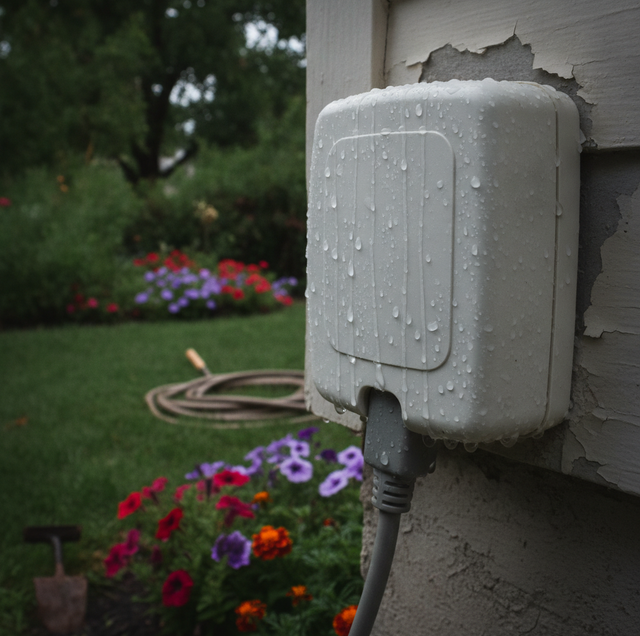
You go to plug in the pressure washer, the string lights, or the pond pump, and the outlet is dead. You press the little button, it clicks back on, and an hour later, it trips again. An outdoor GFCI that keeps cutting power is one of the more frustrating problems around a house, partly because the outlet is usually doing its job. It is not broken for the sake of being annoying. It is reacting to something.
Understanding what it reacts to is the whole game. Once you know the mechanism, the pattern of when it trips tells you most of what you need to know, and a few safe checks will point at the cause without anyone touching a wire.
Quick Answer: An outdoor GFCI trips when it detects a small amount of current leaking to ground instead of returning through the neutral wire. Outdoors, the number one source of that leak is moisture, from rain, sprinklers, or condensation getting into the outlet box, the cover, or a plugged-in cord. Less often, it is a faulty appliance, an overloaded circuit, a worn-out GFCI, or corroded wiring. The trick is watching when it trips: after water means moisture, only with one device means that device, and random tripping points at the GFCI or wiring itself.
What a GFCI Actually Watches For
A ground-fault circuit interrupter is a comparison device. Electricity flowing out to your appliance through the hot wire should return in an equal amount through the neutral wire. The GFCI constantly measures both. When those two amounts stop matching, even by a tiny margin, it means some current is escaping the circuit and traveling to ground by another path. That path could be a wet outlet, a frayed cord, or, in the worst case, a person.
The sensitivity here is deliberately high. A GFCI reacts to a leak of roughly 5 milliamps, a current far too small to run anything but large enough to hurt or kill someone. So when it snaps off, it is not overreacting. It caught a difference between hot and neutral and shut the circuit down faster than you could let go of a live wire. That is the safety margin working exactly as designed.
Think of it like a bucket brigade passing water hand to hand. As long as every bucket that leaves the front of the line comes back full at the end, the line keeps moving. The moment a bucket comes back short, someone downstream is spilling, and the whole line stops until the spill is found. The GFCI is the person counting buckets, and it stops the line the instant the count is off.
Outdoors, that spill is almost always water. Which is why the first question is never "is the outlet bad," but "where is the current getting out."
Moisture: The Number One Outdoor Cause
Water is a conductor, and outdoor outlets live in a world of rain, irrigation overspray, morning condensation, and the dust and mineral film that dry, dusty weather leaves behind. When moisture bridges the contacts inside an outlet, seeps into a receptacle box, or collects at the plug end of a cord, it creates an alternate path to ground that the GFCI is built to detect. The result is a trip.
The tells are usually obvious once you look for them. The outlet holds fine through a dry stretch, then trips during or right after rain. It trips like clockwork twenty minutes into the sprinkler cycle because a head is throwing spray across the box. It is fine by afternoon, but dead every morning when overnight condensation has settled inside a cover. Heavy storms and irrigation are the two heavy hitters, and both come and go, which is why moisture trips can feel random until you connect them to the water.
The two things that stop most weather-related tripping are a proper weatherproof cover and a dry box. If the outlet has a flat cover, or no cover, or a box that has been letting water in for years, moisture has an open invitation.
The Cover Problem, and Why the Flat Kind Is Not Enough
Many outdoor outlets were fitted with a simple flip-up flat cover. That style protects the outlet only when nothing is plugged in. The moment you plug something in, the little door props open on the cord, and the receptacle sits exposed to whatever falls on it. For a permanently connected pump or a set of lights that stay out for weeks, that is a receptacle bathing in every rainstorm.
The fix is an in-use cover, sometimes called a bubble cover. It is a deep-hinged enclosure that closes over the outlet with the cord still plugged in, keeping rain off the connection while power is being drawn. If your tripping outlet powers anything long-term outside, the cover style is one of the first things worth checking.
The Device Itself Might Be Leaking
Sometimes the GFCI is right about the leak, but the leak is inside whatever you plugged in. Motors and heating elements are the usual suspects. An older refrigerator in the garage, a pool or pond pump, a well pump, a submersible fountain, or even a long run of holiday lights can develop internal leakage as insulation ages and windings break down. A cord that got nicked by a lawn mower or chewed by a rodent does the same thing, offering current a shortcut to ground through the damage.
When one specific appliance is the culprit, the pattern is tight: the outlet is solid until that thing is plugged in and running, then it trips. Swap the appliance out and the tripping stops. That is your answer, and it usually means the appliance or its cord needs repair or retirement, not the outlet.
Too Many Devices on One Circuit
Every device leaks a whisper of current to ground. A little is normal and well below the trip threshold. But plug in several devices at once, each contributing its small share, and the combined leakage can climb past the 5-milliamp line even though no single item is faulty. This is why a circuit that runs fine with the lights alone will trip the moment the pump and the pressure washer join in.
Overload leakage looks different from a single-device fault. It only shows up when a certain combination is running together, and thinning the load, moving one device to a different circuit, makes it go away. It is a genuine signal, not a false alarm, so the answer is to spread the load rather than ignore it.
A Worn-Out GFCI, or Corrosion in the Box
GFCIs are electronic devices, and they wear out. Years of heat, cold, humidity, and the occasional real fault take a toll on the internal components, and an aging unit can start tripping for no external reason or fail to reset even when everything is dry and unplugged. Outdoor units in a damp box age faster than those living in a climate-controlled room.
Corrosion is the quieter cousin. Where moisture has been getting into a box for a long time, terminal screws and wire connections oxidize. Corroded connections create high resistance and small leakage paths of their own, feeding the GFCI exactly the kind of imbalance that makes it trip. This is wiring territory, not a homeowner fix, but it is worth knowing as a cause when the simpler explanations have been ruled out.
One Outlet Can Trip for Another Outlet's Problem
Here is the part that sends people chasing the wrong outlet. A single GFCI receptacle often protects several ordinary outlets wired downstream of it on the same circuit. That is by design and perfectly normal. But it means the GFCI can trip because of a fault at one of those downstream outlets, not at the GFCI itself.
So the outlet that went dead may be innocent. The moisture or the leaky device might be two outlets away, on the far side of the yard, all protected by the one GFCI at the front of the run. This is why a real diagnosis checks the whole circuit, not just the receptacle that lost power.
Reading the Pattern: Your Fastest Clue
Before touching anything, watch the timing. It sorts the causes better than any single test.
- Trips after rain, watering, or overnight: moisture is the leading suspect. Look at the cover and whether the box is dry.
- Trips only when one specific device is plugged in and running: that device, or its cord, has developed leakage.
- Trips when several things run at once but not individually: combined leakage from an overloaded circuit.
- Trips at random, even with nothing plugged in and the box bone dry: the GFCI or the wiring, and that is the point to call a pro.
Safe Checks You Can Do Yourself
None of the following involves opening a box or touching a wire. Keep it that way. Water and electricity together are a shock hazard, so if anything is wet, dry it and let it sit before you handle plugs.
Start by unplugging everything from the outlet and pressing RESET. If it holds with nothing connected, the outlet and wiring are probably fine, and something you plugged in is the cause. Add your devices back one at a time, giving each a minute or two before adding the next. The one that trips it stands out immediately.
While you are there, look at the cover and the box. Is it an in-use bubble cover deep enough to close over the cord, or a flat door propped open? Is there standing water, mineral crust, or damp inside? Dry it out and give it time before retesting. Finally, run your hand and eyes along every cord for cracks, nicks, chew marks, or a cracked plug end, because a damaged cord is a common and easily missed leak.
When to Call a Licensed Electrician
Some of this is homeowner territory, and some is not. Call a professional when the outlet trips with nothing plugged in and the box is dry, when you suspect corrosion or a wiring problem, when the GFCI will not reset or no longer responds to its TEST button, or when the tripping simply will not stop after you have cleared the easy causes. Anything behind the faceplate, the wiring, the connections, the device replacement, is licensed work for a reason.
Two rules never bend. Never bypass a GFCI to stop the nuisance, and never swap it for a standard outlet. Whether the trip is a true ground fault or a so-called nuisance trip from moisture, both mean something needs checking, and both are telling you the protection is doing its job. Removing that protection outdoors, in the one place water is guaranteed to show up, trades a minor annoyance for a serious shock risk.
Frequently Asked Questions
The timing tells you which kind of moisture is at fault. A trip during or right after a storm or watering means liquid water actually reached the contacts, while an overnight trip with no rain usually means condensation formed inside the cover as the temperature dropped through the night. So when it trips, it separates direct wetting from condensation, and that steers the fix. Direct wetting points at a cover or box letting water in; condensation points at a poorly sealed enclosure that needs to breathe or drain.
Unplug everything, reset the GFCI, then add devices back one at a time, giving each a minute so the one that trips it stands out. If unplugging everything does not stop the trips, the leak is in the wiring or the box itself, rather than anything you connected. At that point, an electrician uses a clamp meter to measure the leakage current on the circuit and identify which branch or device is bleeding to ground, pinpointing the fault without guesswork.
Yes. A GFCI protects everything wired downstream of it, so a single outdoor GFCI can trip because of moisture or a fault at another outlet on the same circuit. That is why the whole run gets checked, not just the one that went dead. In many homes, the outlet that trips is indoors, in a garage or bathroom, and the real trouble is an exterior receptacle it feeds.
It is a hinged weatherproof cover deep enough to close over a plugged-in cord, so the outlet stays sealed while something is plugged in. Look for one marked extra-duty and while-in-use, and note that it has to be mounted so that a plugged-in cord exits downward. A cover installed the wrong way lets rain run down the cord and straight into the outlet, which defeats the whole point and causes the repeat trips it was meant to prevent.
No. The GFCI is what protects people from electrocution in a wet outdoor location, so removing it hides a real leak and creates a serious shock hazard. Code requires GFCI protection there anyway. A standard outlet has no way to detect current escaping to ground, so it would keep supplying power straight through the exact fault the GFCI kept catching.
Press its TEST and RESET buttons. If it will not reset with nothing plugged in and the box is dry, or it no longer trips when you press TEST, the device has likely worn out, since GFCIs do age and fail over years, especially in a damp outdoor spot. A unit that has quietly stopped responding to TEST is the more dangerous case, because it may be passing power without any protection at all.
Book a diagnostic visit — stop the trips and keep your outdoor circuits protected. RSB Electrical Inc. serves Mesa and the Phoenix Valley. ROC 167102. Call (480) 485-4284.